Notes – Artificial Intelligence For Everyone | CBSE Class 11 AI (843)
“Conquer Class 11 AI (843) with these smart notes!”
Step into the world of Artificial Intelligence with these complete, easy-to-understand notes for CBSE Class 11 AI (843). This AI for Everyone Notes designed to learn faster, revise smarter, and stay exam-ready. It covers all important topics, key concepts, and examples. Whether you’re preparing for internal assessments or board exams, this one step guide will help you understand AI, confidently tackle questions and boost your performance.
What is Artificial Intelligence (AI)?
- Artificial intelligence (AI) refers to the ability of a machine to learn patterns and make predictions.
- Artificial Intelligence is a field that combines computer science and robust datasets to solve problems.
- AI works as a smart assistant and enhances and supports human decision-making.
- It learns from examples and can perform tasks on its own without needing instructions every time.
- AI can
- Understand Language: AI can understand and respond to what we say, like Siri or Alexa.
- Recognize Images: AI can identify objects or things in pictures.
- Make Predictions: AI can study data to predict things like weather or suggestions.
- Play Games: AI can play games and improve by learning from experience.
- Drive Cars: AI helps cars drive safely by understanding the road and making decisions.
What is not AI?
| Type | Explanation | Example |
| Traditional Rule-Based Systems | Follow fixed rules and do not learn from data | Traffic light with fixed timing |
| Simple Automation Tools | Perform specific tasks but do not think or learn | Calculator |
| Mechanical Devices | Work on physical principles without learning | Pulley |
| Fixed-Function Hardware | Do fixed tasks without adapting or learning | Microwave oven |
| Non-Interactive Systems | Do not change with new information | Basic electric fan |
| Basic Sensors | Collect data but do not analyze it | Temperature sensor |
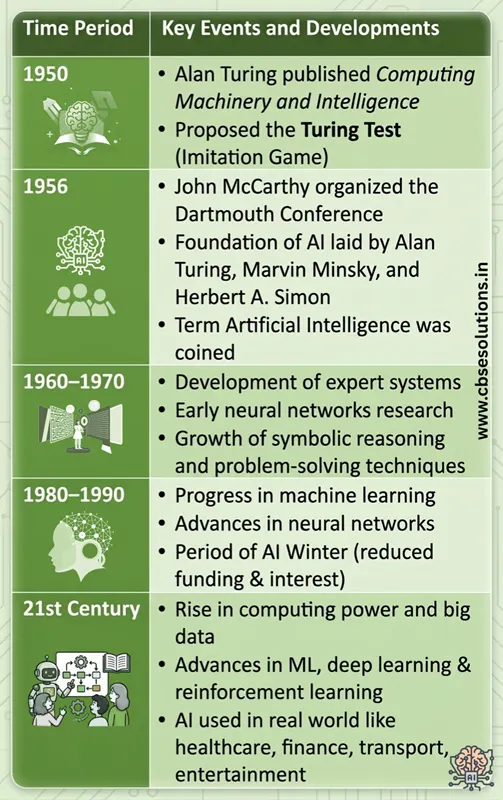
Evolution of AI
Types of AI
1. Narrow AI (Weak AI):
• Designed for a specific task (e.g., voice assistants, recommendations)
• Widely used in everyday applications such as virtual assistants like Siri
• Efficient in one area but lacks overall understanding
2. Broad AI (Intermediate AI):
• More versatile than Narrow AI
• Can handle wider range of related tasks
• Used in businesses for domain-specific solutions
3. General AI (Strong AI):
• Can perform any intellectual task like humans
• Requires thinking, reasoning, and creativity
• Still under development; not yet achieved
What is data?
- Data includes facts, statistics, opinions, or any content that is recorded in some format.
- It can be in different forms like text, audio, images, or videos
- Data is present everywhere around us and influences our experiences, decisions, and interactions.
Types of data
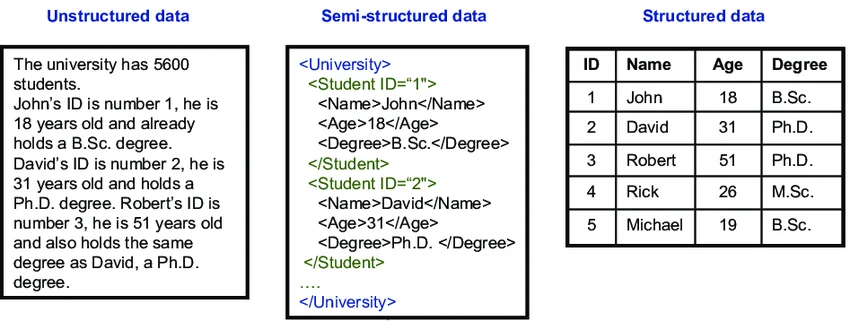
Data can be classified into three different types which are as follows:
- Structured Data
- Unstructured Data
- Semi-structured Data
Structured Data:
- Organized in rows and columns (like tables)
- Easy to store, analyse, and process
- Examples: names, dates, addresses, stock prices
Unstructured Data:
- No fixed format or organization
- Difficult to analyse directly
- Examples: images, text documents, comments, videos
Semi-Structured Data:
- Partially organized using tags or metadata
- Easier to handle than unstructured data
- Example: social media posts with hashtags
Domains of AI
- AI domain is a specific field where AI is applied.
- Each AI domain works on a particular type of data.
- Based on the type of data used, AI is broadly categorised into three domains.
- Statistical Data (Data Science)
- Computer Vision
- Natural Language Processing
1. Statistical Data (Data Science)
- Statistical data refers to numerical, categorical, and alphanumeric inputs.
- Deals with collecting, interpreting, and analysing large datasets.
- Uses statistical methods, machine learning algorithms, and data visualization techniques to extract patterns.
- Example:
- Search recommendations and Google Maps history
- Amazon’s personalized recommendations
- Social media activity, cloud storage, and digital textbooks
- Price Comparison Websites
- Temperature prediction
2. Computer Vision (CV)
- Enables machines to interpret, analyse, and understand visual information
- Process includes image acquisition, screening, analysis, and extraction.
- Input types: photos, videos, thermal/infrared images
- Digital images are made of Pixels, each storing colour and intensity information.
- Resolution is the total number of pixels along the width and height of an image (e.g., 1920 × 1080)
- AI algorithms converts images into numbers and learns patterns from data to recognize objects accurately
- Examples:
- Face recognition
- Self-driving car
- Augmented reality
- Medical imaging
- Image classification
3. Natural Language Processing (NLP)
- Enables interaction between humans and computers using natural language
- It includes tasks such as language translation, sentiment analysis, text summarization and speech recognition
- Aims to understand context, meaning, slang, and sarcasm in language
- Examples:
- Machine Translation (Google Translate, Microsoft Translator)
- Email Filters (spam detection)
- Grammer prediction
- Search engine
Difference between NLP, NLU and NLG
| Term | Definition | Example / Idea |
| Natural Language Processing (NLP) | Broad field that deals with how computers work with human language | Like a library with many tools for language tasks |
| Natural Language Understanding (NLU) | Focuses on understanding meaning, intent, and sentiment in language | Like finding and understanding a specific book |
| Natural Language Generation (NLG) | Focuses on generating human-like text or speech from data | Like writing a new book from gathered information |
AI Terminologies
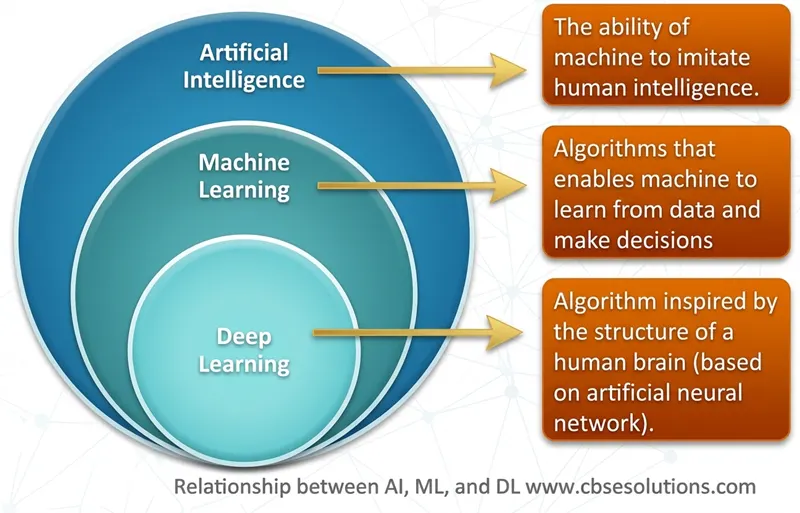
Machine Learning
- Machine Learning (ML), a subset of AI, enables machines to improve their performance with experience.
- By learning from data, ML systems refine their predictions, correct mistakes, and achieve better results over time — without being explicitly programmed.
Deep Learning
- Deep Learning (DL), a subset of Machine Learning, uses artificial neural networks inspired by the human brain.
- It automatically learns complex patterns from vast amounts of data and performs specific tasks with high accuracy.
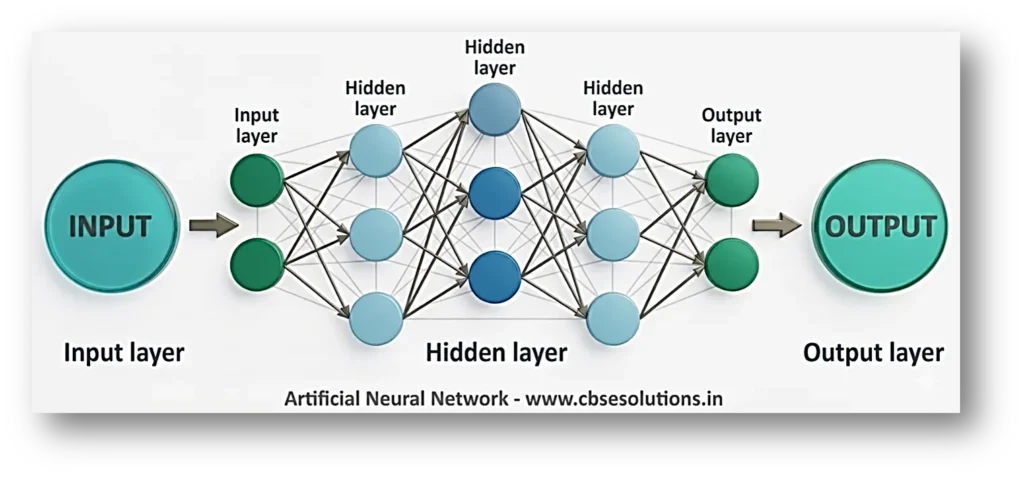
Artificial Neural Network
- Neural networks, also known as Artificial Neural Networks (ANNs) are a subset and core of Machine Learning
- Artificial Neural networks are modelled on the human brain and nervous system
- A Neural Network is made up of multiple layers, and each layer contains small units called nodes
- Neural Network consists of Input layer, Hidden layer and Output layer.
- If a node’s output exceeds a set threshold, it activates and passes data to the next layer; otherwise, no data is forwarded.
- A neural network with more than three layers (including input and output) is called a Deep Neural Network.
Difference between ML and DL
img
Types Of Machine Learning
img
Supervised Learning
- Uses labelled dataset (data with correct answers/tags)
- The algorithm learns by comparing input with correct output during training phase
- It tries to map inputs to outputs by finding patterns in the data.
- Used to predict or classify new or unseen data
- Examples of Supervised Learning:
- Linear Regression
- Logistic Regression
- Decision Trees
- Support Vector Machines (SVM)
- Neural Networks
Unsupervised Learning
- model learns from unlabeled data (inputs without correct outputs)
- The algorithm identifies hidden patterns or structures in the data without supervision.
- Machine analyses data on its own to find patterns, similarities/differences in data.
- The main goal is to discover inherent relationships such as clusters, associations, or anomalies.
- Examples of Unsupervised Learning:
- K-Means Clustering
- Hierarchical Clustering
- Principal Component Analysis (PCA)
- Autoencoders
Reinforcement Learning
- Agent learns by trying different actions and learning from mistakes (trial and error)
- Receives feedback as reward (right) or penalty (wrong)
- It’s a type of learning where agent learns by interacting with an environment to maximize rewards.
- The agent learns through trial and error, receiving rewards or penalties based on its actions.
- The goal is to learn a policy that guides actions to achieve the highest cumulative reward over time.
- It is used in tasks requiring sequential decision-making, such as games, robotics, or financial portfolio management.
- Examples of Reinforcement Learning:
- Q-Learning
- Deep Q-Networks (DQN)
- Policy Gradients
- Actor-Critic methods.
Benefits of AI
- Increased efficiency and productivity: AI automates tasks and optimizes processes for faster results.
- Improved decision-making: AI analyses complex data to provide accurate, data-driven insights.
- Enhanced innovation and creativity: AI handles repetitive work, allowing humans to focus on innovation.
- Advancements in science and healthcare: AI accelerates research, diagnosis, and personalized treatments.
- Cost reduction: AI lowers operational costs by improving efficiency and reducing errors.
- Enhanced customer experience: AI delivers personalized services, recommendations, and support.
Limitations of AI
- Job displacement: AI automation may replace jobs, requiring workforce retraining.
- Ethical considerations: AI can be biased or misused, needing clear ethical guidelines.
- Lack of explainability: Complex AI models are often difficult to interpret.
- Data privacy and security: AI relies on large datasets, raising privacy and security risks.
- Dependence on data quality: Poor or biased data can lead to inaccurate AI outputs.