AI Reflection Project Cycle and Ethics Notes – Class 9 AI (417)
Master AI Reflection Project Cycle and Ethics with this best CBSE-aligned Notes covering every topic in simple, pointwise, and easy-to-understand language. This AI Reflection Project Cycle and Ethics notes of of Class 9 AI (417) Includes every concepts of AI Reflection, AI Project Cycle, and AI Ethics and Morality to help students revise quickly and score full marks in exams.
🧭 Related Resources
- 🎯Class 9 Artificial Intelligence(417)
- 🗂️Class 9 Employability Skills
- ✅ AI Reflection, Project Cycle and Ethics MCQs
- 📝 AI Reflection, Project Cycle and Ethics PYQs
- ❓ AI Reflection, Project Cycle and Ethics Imp. Questions
AI Reflection
What is Artificial Intelligence?
Artificial Intelligence (AI) is the ability of a machine to imitate human intelligence.
A machine is said to possess artificial intelligence when a machine can make decisions, solve real world problems, learn and improve from past experience, and predict outcomes on its own.
How to make machine intelligent?
- Like humans, machines also become intelligent by learning from data and information.
- Machines become artificially intelligent when they are trained using data and information.
- Training helps machines perform tasks such as decision-making, prediction, and problem-solving.
- AI machines can learn from past experiences and improve their performance over time.
- Continuous learning helps AI systems provide better and more accurate results.
Applications of Artificial Intelligence (AI)
Face Lock in Smartphones
- Modern smartphones use AI-based face lock systems for security.
- The front camera captures and stores the facial features of the owner during setup.
- Whenever the user tries to unlock the phone, the camera matches the stored features with the current face.
- If the features match, the smartphone gets unlocked.
Smart Assistants
- Smart assistants such as Siri and Alexa use AI technology.
- They recognize speech patterns, understand commands, and provide useful responses.
- These assistants help users perform tasks like setting alarms, playing music, and searching information.
Fraud and Risk Detection
- Banks and finance companies use AI to detect fraud and reduce financial risks.
- AI analyses customer data such as past transactions, spending habits, and loan history.
- It helps companies predict the chances of fraud or loan default.
- AI also helps banks suggest suitable financial products according to a customer’s purchasing power.
Medical Imaging
- AI is widely used in medical imaging and healthcare.
- It helps doctors create and analyse medical images more accurately.
- AI can convert 2D scan images into interactive 3D models for better understanding of a patient’s condition.
- It also assists doctors in diagnosing diseases and planning treatments more effectively.
Internet Search Engines
- Search engines like Google use AI to provide fast and accurate search results.
- AI also helps in auto-correction, search suggestions, and predicting what users want to search.
AI, ML & DL
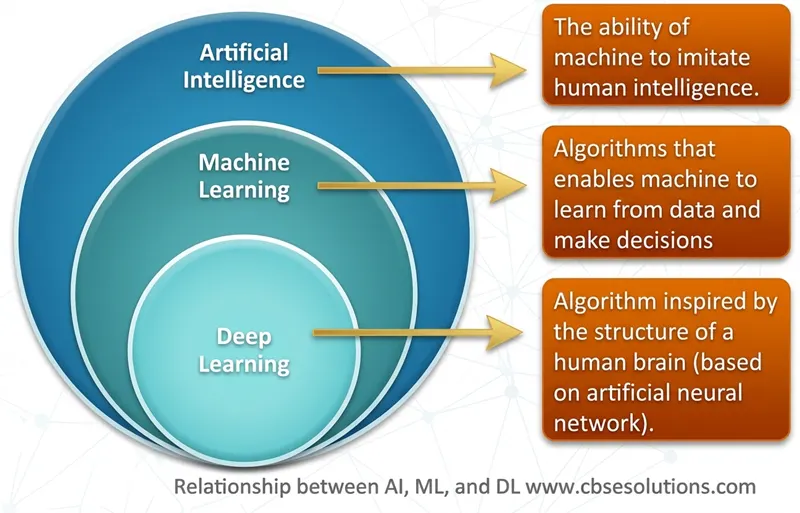
Artificial Intelligence (AI)
- Artificial Intelligence (AI) refers to techniques that enable computers to mimic human intelligence.
- AI-enabled machines work on algorithms and data to give intelligent outputs.
- AI is the broadest concept among AI, ML, and DL.
- AI includes all systems that can perform tasks intelligently.
Machine Learning (ML)
- Machine Learning (ML) is a subset of Artificial Intelligence.
- ML enables machines to improve their performance through experience.
- The machine learns from new data and past mistakes.
- ML models improve themselves during future executions.
Deep Learning (DL)
- Deep Learning (DL) is a subset of Machine Learning.
- DL enables software to train itself using vast amounts of data.
- It uses multiple machine learning algorithms together to perform tasks.
- Deep Learning systems are capable of developing algorithms on their own.
Introduction to AI Domains
Based on the type of data used, AI can be broadly divided into the following domains:
Statistical Data (Data Science)
- Statistical Data is numerical or tabular data used to analyse and draw useful insights.
- It helps AI systems identify patterns, trends, and useful information from data.
- Examples: weather prediction, fraud detection, and recommendation systems.
Computer Vision
- Computer Vision enables machines to understand and interpret images and videos.
- It helps computers recognize objects, faces, text, and movements visually.
- Examples: face lock in smartphones, medical imaging, and self-driving cars.
Natural Language Processing (NLP)
- Natural Language Processing helps machines understand and respond to human language.
- It enables computers to read, listen, speak, and interpret text or speech.
- Examples: chatbots, voice assistants, language translation, and speech recognition.
AI Project Cycle
AI Project Cycle and Its Stages
The AI Project Cycle is a step-by-step process used to develop AI-based solutions to real-world problems. It helps in creating, training, and evaluating AI models in an organized way.
AI Project Cycle consist of six main stages:
- Problem scoping – Identify and understand the problem and define the goal of the AI solution.
- Data Acquisition – Collect relevant and useful data from reliable sources.
- Data Exploration – Clean, arrange and prepare data for analysis
- Modeling – Train an AI model using algorithms to learn from the data and make decisions
- Evaluation – Test AI model in different ways to analyse its performance.
- Deployment – Implementing trained AI model into real world setting.
What is AI Project Cycle Mapping?
- AI Project Cycle Mapping means relating the steps of a project to the stages of the AI Project Cycle.
- It helps in understanding how each project activity is connected with AI processes.
Example: AI Project Cycle Mapping – Pest Management Project
1. Problem Scoping
- Identify the problem of insects damaging cotton plants.
- Define the goal to detect insects visually and reduce crop damage.
- Understand the requirements and expected results of the AI solution.
2. Data Acquisition
- Collect images and data of healthy and infected cotton plants.
- Gather data from farms, farmers, and agricultural records.
- Store the collected data for training the AI model.
3. Data Exploration
- Study and analyse the collected data carefully.
- Identify patterns and differences between healthy and infected plants.
- Clean and organize the data for better understanding and analysis.
4. Modeling
- Create and train an AI model using the prepared data.
- Teach the model to recognize insects and affected plants.
- Improve the model so that it can provide accurate results.
5. Evaluation
- Test the AI model using new plant images and data.
- Check the accuracy and performance of the model.
- Make improvements if the model gives incorrect results.
6. Deployment
- Implement the AI model in a real-world application or mobile app.
- Allow farmers to use the AI system for pest detection.
- Continuously update the model to improve its performance over time.
Why do we Need an AI Project Cycle?
1. Efficiency
- The AI Project Cycle helps in creating better AI solutions easily.
- It makes the development process faster and more organized.
2. Modularity
- The AI Project Cycle breaks a large project into smaller and manageable parts.
- Each stage can be worked on separately and systematically.
Problem Scoping
Problem scoping is first stage of AI Project Cycle. It involves followings to solve using AI:
- Define the problem
- Understand the problem
- Structure the problem
How problem scoping is done
Problem scoping is done using 4Ws canvas.
4Ws canvas
The 4Ws canvas is a framework that helps in defining and understanding key elements of problem.
Who
“Who are the stakeholders?”
- The “Who” block identifies the people who are directly or indirectly affected by the problem.
- It helps in understanding the needs and expectations of the stakeholders.
What
“What is the problem?”
- The “What” block focuses on identifying and understanding the problem clearly.
- It helps in defining the exact nature and cause of the problem.
Where
“Where does the problem arise?”
- The “Where” block identifies the location or situation where the problem occurs.
- It helps in understanding the context and environment of the problem.
Why
“Why should the problem be solved?”
- The “Why” block explains the importance and benefits of solving the problem.
- It helps in understanding how stakeholders will benefit from the AI solution.
Problem Statement Template
- A Problem Statement Template helps in summarizing all the important details of a problem in a structured format.
- It helps in understanding the problem clearly and keeps all key points in one place.
- It can be referred to in the future to quickly understand the basis and goal of the project.
4W Canvas for Smart Traffic Management
| Statement | Details | Component |
| Our | City commuters and traffic police | Who |
| has a problem that | traffic congestion and long waiting times on roads | What |
| when / while | travelling during busy hours in cities | Where |
| An ideal solution would | create an AI-enabled traffic management system that controls traffic signals, reduces congestion, saves travel time, and improves road safety | Why |
Data Acquisition
- Data Acquisition is the process of collecting relevant data for an AI project.
- Data can include facts, numbers, images, videos, audio, or text collected for analysis and training.
- AI systems learn and make predictions using the collected data.
What is Data?
- Data refers to facts, information, statistics, images, audio, videos, or numbers collected for reference and analysis.
- AI systems use this data for learning patterns and making decisions..
Training Data
- Training data is the main data fed to teach the AI Model.
- It helps the AI Model learns from this data and find patterns and relationships.
- For any AI project to be efficient, the training data should be authentic and relevant to the problem statement scoped.
Testing data
- Testing data is predicted data set by an AI Model.
- It’s the new data that the AI model has never seen before.
Example
- Suppose we want to build an AI system that predicts an employee’s future salary.
- The machine is trained using the employee’s previous salary records.
- These previous salary records are called Training Data.
- After training, the AI system predicts the future salary using Testing Data.
Data features
- Data feature refers to type of data that help an AI model understand it.
- They are input for the AI Model
From where we can acquire data?
There are various ways we can collect data. Some of them are given below:
Survey – collecting your own data by asking people directly like – fill form, opinion poll, feedbacks
Web scraping/websites – online data sources like news sites, e-commerce platform, government sites
Sensors – devices that collect real time data like – smart watches (heart rate), thermometer (temperature)
Cameras – collecting images, live data
Observations – collect real and natural data by carefully watching and listening like body language, emotions, behaviors
API (Application Programming Interface) – set of code help one application to connect another like – weather API, Google MAP API
System Maps
- A System Map shows the components and boundaries of a system and the components of the environment at a specific point in time.
- With the help of System Maps, one can easily define relationships among different elements within a system.
- In an AI project, the goal of the project becomes a system whose elements are the data features used in the project.
- Any change in these elements can change the outcome of the system.
Example
- Suppose an AI system is predicting a person’s future salary.
- If the person receives a 200% increment in salary, this change will affect the prediction of future salary.
- The system may predict a higher future salary because of the present increment.
Data Exploration
- It is the process of examining and analyzing data to discover patterns, trends, relationship and anomalies within the data.
- In Data Exploration, students explore different types of graphs and visual representations used in data visualization.
Importance of Data Exploration
- Helps in identifying trends, patterns, and relationships in data.
- Helps in selecting suitable AI models at later stages.
- Makes it easier to communicate information effectively to others.
Data Visualization
- Data Visualization means representing data using graphs, charts, diagrams, or other visual formats.
- Visual representations make data easier to understand and analyse.
- Different visualization techniques are suitable for different types of data.
Data Visualization Techniques
| Visualization Technique | One-line Description | Suitable Data Type |
| Bar Graph | Represents comparison between categories using bars | Categorical Data |
| Line Graph | Shows changes and trends over time | Continuous Data |
| Pie Chart | Shows parts of a whole using sectors | Percentage Data |
| Histogram | Represents frequency distribution of data | Numerical Data |
| Scatter Plot | Shows relationship between two variables | Correlation Data |
Modelling
- AI Modelling refers to developing algorithms or models which can be trained to give intelligent outputs.
- It involves writing codes to make a machine artificially intelligent.
Types of AI Models
Rule based Model
- In a Rule-Based Approach, rules are defined by the developer.
- The machine follows the predefined rules and instructions to perform tasks.
- The machine gives outputs according to the conditions and rules fed into it.
Example:
Problem:
You want to build an AI system that can recommend clothes based on weather.
Rules Defined:
- If temperature > 30°C → recommend “Wear light cotton clothes.”
- If temperature between 15°C and 30°C → recommend “Wear normal clothes.”
- If temperature < 15°C → recommend “Wear warm clothes.”
- If it’s raining → recommend “Carry an umbrella.”
How It Works:
This AI doesn’t learn from data. It follows fixed rules defined by humans. Based on the input (like temperature or rain), it gives a fixed output.
Limitations of Rule-Based Model
- Learning in this approach is static.
- The machine does not automatically adapt to new changes in the data.
Learning based model
- In a Learning-Based Approach, the machine learns by itself from data.
- The AI model creates its own algorithm by analysing patterns in the data.
- The model can adapt itself according to changes in data.
Example:
Student Marks Prediction
You give the AI system data like this:
| Study Hours | Marks |
| 2 | 40 |
| 4 | 60 |
| 6 | 80 |
The AI learns the pattern that more study hours = more marks.
Now, if you ask it to predict marks for 5 hours of study, it might say 70 marks — even though you never told it this directly.
Advantage of Learning based Model
- The model can handle new and different data efficiently.
- It continuously improves and adapts according to the training data.
Evaluation
- Evaluation is the process of checking the reliability and performance of an AI model.
- In this stage, the model is tested using Testing Data and its outputs are compared with actual answers.
- Different evaluation techniques are used depending on the type and purpose of the AI model.
Parameters to check Model is working efficiently
- Accuracy
- Precision
- Recall
- F1 score
Model Evaluation Terminologies
- While evaluating an AI model, different terminologies are used to understand the performance of the model.
- Evaluation is done by comparing the model’s prediction with the actual result.
- Two important terms used in model evaluation are:
- Prediction
- Reality
Prediction
- Prediction is the output given by the AI model.
- It shows what the machine predicts based on the data provided to it.
Reality
- Reality is the actual situation in the forest at the time of prediction.
- It shows whether a forest fire has really occurred or not.
Cases in Model Evaluation
1. True Positive
- The prediction given by the model is correct.
- The actual condition is “Yes” and the model also predicts “Yes”.
2. True Negative
- The prediction given by the model is correct.
- The actual condition is “No” and the model also predicts “No”.
3. False Positive
- The prediction given by the model is incorrect.
- The actual condition is “No” but the model predicts “Yes”.
4. False Negative
- The prediction given by the model is incorrect.
- The actual condition is “Yes” but the model predicts “No”.
Example: Forest Fire Prediction System
The Scenario
- Imagine an AI-based prediction model deployed in a forest that is prone to forest fires.
- The objective of the model is to predict whether a forest fire has occurred or not.
- To check the efficiency of the model, we compare the model’s prediction with the actual situation.
| Reality | Prediction | Result |
| Forest fire occurred | Model predicts “Yes” | True Positive |
| No forest fire occurred | Model predicts “No” | True Negative |
| No forest fire occurred | Model predicts “Yes” | False Positive |
| Forest fire occurred | Model predicts “No” | False Negative |
Deployment
- Deployment is the final stage in the AI Project Cycle.
- In this stage, the AI model or solution is implemented in a real-world scenario.
Key Steps in Deployment Process
1. Testing and Validation of the AI Model
- The AI model is tested and validated before deployment.
- This helps in checking the accuracy and performance of the model.
2. Integration with Existing Systems
- The AI model is integrated with existing systems and applications.
- This helps the model work properly in real-world environments.
3. Monitoring and Maintenance
- The deployed AI model is continuously monitored.
- Maintenance is performed to improve the performance of the model.
Examples of AI Deployment
- Self-driving cars
- Medical diagnosis systems
- Chatbots
Platforms for AI Applications
- Mobile Apps
- Website Apps
Ethics and Morality
Ethics vs Morals
| Ethics | Morals |
| Guiding principles that help decide what is right or wrong | Beliefs and values followed by individuals or society |
| Ethics help in decision-making | Morals are personal or social beliefs |
| Ethics may differ according to situations | Morals may differ from person to person or society to society |
Ethics with Personal Data
- Around 5.34 billion smartphone users worldwide had their information available on the internet as of July 2022.
- AI can collect and analyse data related to a particular person from the available online data.
- Organizations use AI solutions to provide customized recommendations for products, songs, videos, and other services.
- AI can influence people’s choices and decision-making processes.
- Therefore, ethical principles are needed to govern the use of AI and the people who develop AI systems.
Major Issues around AI Ethics
- AI systems can sometimes make incorrect or unfair decisions.
- Bias in training data can lead to discrimination against certain groups of people.
- Personal and private data collected by AI may be misused or leaked.
- AI systems may influence people’s choices and decision-making.
- Lack of transparency in AI systems can make it difficult to understand how decisions are made.
- AI may affect jobs and employment opportunities due to automation.
- Some AI systems may exclude certain groups of people and create inequality.
- Therefore, ethical principles are important to ensure AI is fair, safe, and beneficial for everyone.
AI Ethics Principles
Identifying the Principles
- To make AI better, we need to identify the factors responsible for it.
- The following AI Ethics principles affect the quality of AI solutions:
- Human Rights
- Bias
- Privacy
- Inclusion
Human Rights
- While building AI solutions, it is important to ensure that human rights are protected.
- AI systems should respect people’s freedom and equality.
Points to Consider
- Does the AI take away freedom?
- Does the AI discriminate against people?
- Does the AI deprive people of jobs?
- What other human rights should be protected while using AI?
Bias
- Bias means partiality or preference for one person or group over another.
- Bias in AI often comes from the collected training data.
- If the data is biased, the AI results may also become biased.
Points to Consider
- Does the data represent all sections of the population equally?
- Will the AI discriminate against certain groups of people?
- Does the AI exclude some people?
- What other biases can appear in AI systems?
Privacy
- Privacy means keeping personal and private data safe and secure.
- AI systems should use personal data responsibly.
Points to Consider
- Does the AI collect personal data from people?
- What does the AI do with the collected data?
- Does the AI inform people about the data being collected?
- Will the AI ensure safety or compromise privacy?
- In what other ways can AI breach privacy?
Inclusion
- AI should not discriminate against any group of people.
- AI systems should benefit all people equally without causing disadvantage.
Points to Consider
- Does the AI leave out any person or group?
- Do rich and poor people benefit equally from the AI system?
- How easy is the AI system to use?
- Who does the AI help?
- How can AI be made more inclusive?
🔗Related Class 10 Evaluating Models Resources
- ✅Practice AI Reflection, Project Cycle and Ethics MCQs
- 📝Solve AI Reflection, Project Cycle and Ethics PYQs
- ❓ Revise AI Reflection, Project Cycle and Ethics Imp. Questions
🔗Explore Other Class 10 AI-417 Notes
🔗Explore Other Class 10 AI-417 MCQs
- Data Literacy Class 9 MCQs
- Math for AI Class 9 MCQs
- Intro to Generative AI Class 9 MCQs
- Intro to Python Class 9 MCQs
🔗Other Helpful Resources
- 📚 Class 9 AI Notes
- 📝 Class 9 AI MCQs
- 📄 Class 9 AI PYQs
FAQs – Introduction to Data Literacy | Class 9 AI (417)
Is the AI Reflection Project Cycle and Ethics chapter difficult?
No, AI Reflection Project Cycle and Ethics chapter difficult nahi hai. Agar students AI Project Cycle ke different stages, important concepts aur ethical issues ko properly understand karein, to ye chapter easily prepare kiya ja sakta hai.
How many marks does unit AI Reflection Project Cycle and Ethics carry in Class 9?
As per CBSE new syllabus, is chapter se max 10 marks ke questions exam me aate hai. but ye school to school vary ho sakta hai, because class 9 AI home exam hai.
Are these AI Reflection Project Cycle and Ethics notes sufficient for exam preparation?
Yes, ye notes chapter ke important concepts, aur key points ko understand aur revise karne ke liye helpful hain. Better exam preparation ke liye notes ke saath MCQs, important questions aur practice questions bhi solve karna chahiye. Meri website me ye sab available hai.
What are the important topics in AI Reflection Project Cycle and Ethics in Class 9 AI?
is chapter me AI Applications, AI vs ML vs DL, Stages of AI Project Cycle, AI Domains, Problem Solving, 4Ws, Training & Testing Data, AI Models and Its types most important topics hai.
Frequently Asked Questions of Class 9 AI
What is subject code of Class 9 AI?
Class 9 AI ka subject code 417 hai. it is an additional/vocational subject offered by CBSE for Class 9.
Is Class 9 AI (417) is compulsory or optional subject?
As per CBSE Guidelines, ye ek optional skill subject hai.
What is the marks weightage of AI in Class 9?
CBSE Class 9 AI (417) ka total assessment 100 marks ka hota hai. Isme 50 marks theory aur 50 marks practical/project work ke liye hote hain.
What topics comes in the Class 9 AI (417) syllabus?
CBSE ke latest Syllabus ke according, you have to learn AI Refelect, Project Cycle & Ethics, Data Lieracy, Math for AI (Statistics), Introduction to GenAI, and Introduction to Python.
What do we have to do in the Class 9 AI practical?
Class 9 AI ke Practicals me students ko Python me minimum 15 programs ki practical file banani hai. ye python programs input and output, variables, arithmetic operations, if conditions, and list pe based hona chahiye. Aap ye practical file meri website se bhi download kar sakte hai.