Advance Concept of Modeling Notes – Class 10 AI (417)
“Want to score well and understand every concept of Advance Concept of Modeling of Class 10 AI (417) easily?”
Don’t worry! These Advanced Concept of Modeling Notes for Class 10 AI will help you build concept clarity and prepare effectively for your CBSE board exams. All key topics are carefully curated as per the latest CBSE syllabus. These AI Modeling Notes of Class 10 are designed in a simple and student-friendly way, making even complex concepts easy to understand. They include important explanations, examples, and exam-oriented points to boost your confidence.
🧭 Related Resources
- 🎯Class 10 Artificial Intelligence(417)
- 🗂️Class 10 Employability Skills
- ✅Advance Concepts of Modeling MCQs
- 📝Advance Concepts of Modeling PYQs
- ❓Advance Concepts of Modeling Imp. Questions
Understand AI, ML and DL
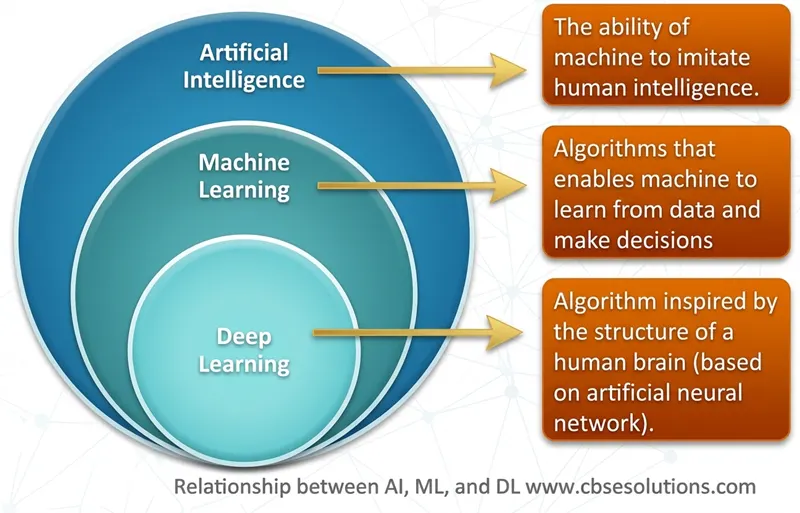
Artificial Intelligence
- Artificial Intelligence (AI) refers to techniques that enable machines to mimic human intelligence.
- AI systems use algorithms and data to analyse information, learn from it, and produce intelligent outputs.
Machine Learning
- Machine Learning (ML), a subset of AI, enables machines to improve their performance with experience.
- By learning from data, ML systems refine their predictions, correct mistakes, and achieve better results over time — without being explicitly programmed.
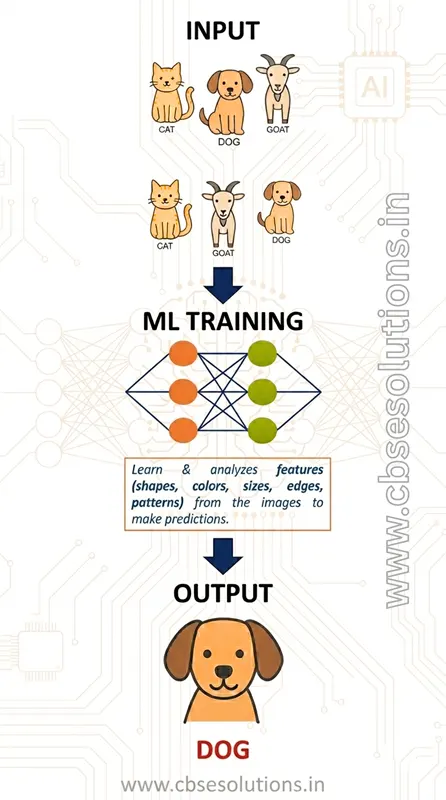
Example: Suppose you are teaching a computer to recognize pets.
- INPUT Layer – You give it data: pictures of dog, cat and goat, along with their names.
- ML training – The computer studies the patterns (like shapes of ears, nose, or size) and learns to identify them.
- OUTPUT Layer – Dog is predicted.
Next time, if you show a new picture of a dog, it can predict that it’s a dog — even though it hasn’t seen that exact picture before.
Examples of Machine Learning
Object Classification
Identifies and labels objects present within an
image or data point. It determines the
category an object belongs to.
Anomaly Detection
Anomaly Detection is used to find unusual or unexpected patterns in data. It helps in identifying anything that deviates from normal behavior.
Recommendation System
A Recommendation System suggests relevant items to users based on their preferences and past behavior.
Deep Learning
- Deep Learning (DL), a subset of Machine Learning, uses artificial neural networks inspired by the human brain.
- It automatically learns complex patterns from vast amounts of data and performs specific tasks with high accuracy.
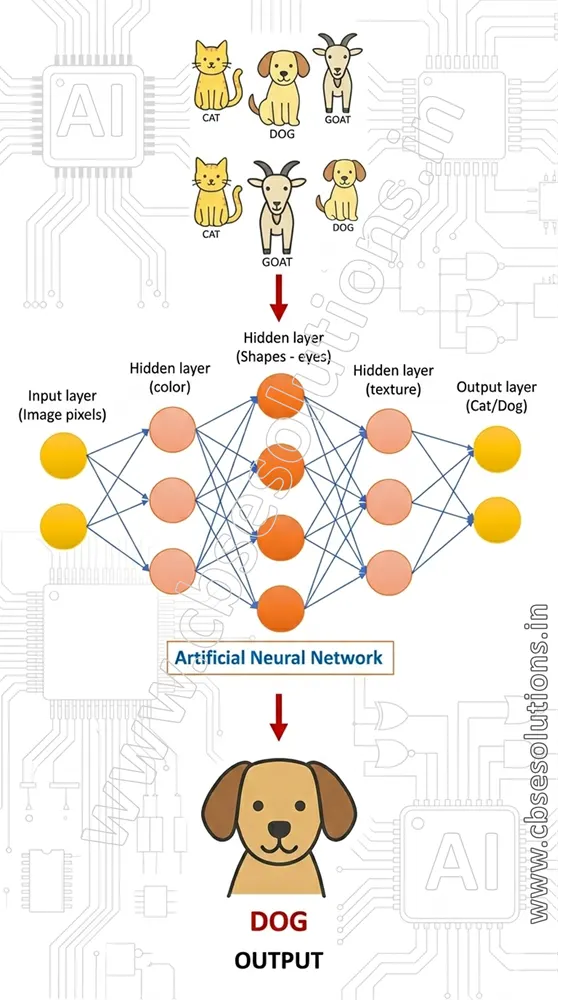
Artificial Neural Network consist of multiple layers such as input layers, hidden layers, and output layers that help ANN automatically learn and recognize complex patterns from data. As the number of layers increases, the network can learn and identify more complex patterns.
Example: Recognizing image of dog or cat
- INPUT Layer: The raw images (pixels) is fed into the ANN.
(In DL, the system automatically figures out these features by itself from thousands of photos — without you telling it what an eye or nose looks like) - HIDDEN Layers:
- First layer learns simple features like – color, edges
- Next layer learns other features (complex) like – eyes, nose
- Next layer (Deeper) learns more complex features like – texture
- These all together create high level of understanding of picture
- OUTPUT Layer: System predicts whether it is dog or cat
Examples of Deep Learning
Object Identification
Object Identification helps a computer detect and label objects in an image.
It understands what is present in the picture and classifies those objects.
Example: Identifying cars, people, or animals in a photo.
Digit Recognition
Digit Recognition helps a computer recognize handwritten numbers. It can understand different writing styles and correctly identify the digits.
Example: Reading numbers on cheques or postal codes.
Face Recognition
Face Recognition allows a computer to identify or verify a person using their facial features.
It learns patterns from images to recognize different faces accurately.
Example: Unlocking a smartphone using face unlock.
Difference between AI, ML and DL
| Feature | AI | ML | DL |
| Definition | Broad field of making machines intelligent | Subset of AI that learns from data | Subset of ML using neural networks |
| Purpose | General human Intelligence tasks | Learning data patterns | Learn complex data patterns |
| Data Requirement | May or may not require large dataset. | Requires large dataset | Require extensive dataset |
| Processing Power | Normal Processing | Moderate Processing | Very high (GPUs) Processing |
| Applications | Chatbots, Robotics, Gaming, Google Translate | Email Filter, Weather Forecasting, Recommendation engine | Image recognition, Speech recognition, NLP, advance AI applications |
Common terminologies used with data
What is data?
- Data is raw facts, figures, text, images given as input to AI/ML model to learn from and make predictions.
- It is information in any form
- Organized in rows and columns
What is Features?
- Features are individual characteristics of data that are used by AI/ML to make decisions
- Columns of the tables are called features
- Some features are special, they are called labels
What is Label?
- Label is the output or target value that AI/ML Model is trained to predict.
- It is the process of assigning meaning to data based on the context of the problem being solved.
Example: Identify Data, Features and Labels from Student Performance Dataset
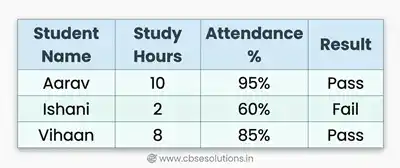
Data – All numbers, names, and percentages organized in the table above
Features – Student Name, Study Hours, Attendance %, Result
Labels – The Result (Pass/Fail) is the label.
Labeled Data and Unlabeled Data
Labeled Data – Data to which some tag or label is attached.
Unlabeled Data – Raw data to which no tag is attached.
What is Training data set?
- Training dataset is collection of examples with inputs(features) used to teach the machine learning model.
- The model learns patterns from this data.
- Set of labeled data is used to train model.
What is Testing data set?
- Testing data is a separate set of examples used to test the accuracy of model.
- Testing data is never seen before by model.
- Test is performed without labelled data and then verify results with labels.
AI Modeling
- AI Modeling refers to developing algorithms (models) to get intelligent outputs.
- It is writing code to make a machine artificially intelligent.
Types of AI Models
IMG
Rule-Based Approach
- AI modeling follows rules defined by developers.
- The machine applies predefined instructions to data to produce output.
- The system does not learn or improve from new data.
Example: Rule-Based Chatbot
- Works on a set of predefined questions and responses
- Uses decision rules (IF condition → THEN action) to reply
- Cannot learn or improve from new situations
- Static models (Once trained, the model cannot improvise)
Limitation of Rule-based approach
- Learning is static (does not change after training)
- Cannot improve or adapt to new data
- Fails when it encounters unseen or different data
Learning-Based Approach
- AI modelling where the machine learns by itself.
- The machine learns from data instead of predefined rules
- It uses input data and feedback (labels/answers) for learning
- The system automatically finds patterns and relationships in data
- It can adapt to new and unseen data
- It is used in Machine Learning and Deep Learning
Example: Spam email filter
- Learns from labelled emails without being explicitly programmed.
- Identifies patterns using features like words, sender, attachments
- Classifies new emails as spam or not spam
- Improves accuracy over time with more data
Difference between Rule based approach and learning based approach
| Basis | Rule-Based Approach | Learning-Based Approach |
| Rules | Defined by developer | Learned by machine |
| Data Usage | Applies rules on data | Learns patterns from data |
| Performance | Fails on unseen data | Handles new/unseen data better |
Categories of Machine Learning based models (Learning Based Approach)
img
Supervised Learning
- Uses labelled dataset (data with correct answers/tags)
- The trainer must know the data to label it correctly
- The model learns by comparing input with correct output
- Similar to a teacher teaching with examples and then testing
- Used to predict or classify new data
Sub categories of Supervised Learning
There are two types of Supervised Learning models:
- Classification model
- Regression model
Classification model
- This model works with discrete data.
- Output is categorical.
- Examples:
- Email Spam detection
- Weather prediction
- Loan approval system
- Face recognition
Regression model
- This model works with continuous data.
- Output is numerical values
- Examples:
- Salary prediction
- Temperature prediction
- Car price prediction
- Sales forecasting (predict future sales)
Unsupervised Learning
- Works on unlabelled data (no correct answers/tags given)
- The person training the model may not know the data details
- The machine learns without any supervision or guidance
- Machine analyses data on its own to find patterns, similarities/differences in data.
- Helps in understanding unknown or raw data
- Learning is based on self-exploration
- Similar to a child learning without a teacher
Difference between Supervised and Unsupervised learning
| Supervised Learning | Unsupervised Learning |
| Uses labelled data | Uses unlabelled data |
| Learns under human guidance | Learns without guidance |
| Predicts output labels | Finds hidden patterns |
| Spam detection, price prediction | Customer segmentation, recommendations |
Sub categories of Unsupervised Learning Model
Unsupervised learning models can be further divided into two categories:
- Clustering model
- Association model
Clustering model
- Groups data points based on similar features or patterns
- Data is not labelled in advance (no categories given)
- The model automatically finds hidden patterns in the data
- Examples:
- Movie recommendation – movies are grouped based on Action, Comedy etc.
- Customer segmentation – group customers based on buying behaviour.
- Email spam filtering – emails grouped into spam, important, promotions etc.
Difference between Classification and Clustering
img
Association model
- Identifies relationships between different variables in a dataset
- Helps understand how one factor influences or is related to another
- Used in product recommendation systems to suggest items based on user behaviour.
- Examples:
- Online Product Recommendations – Buy a laptop → suggestions for mouse, laptop bag, keyboard
- Food Ordering Apps – Order a burger → app suggests fries + cold drink
- Supermarket Offers – Buy shampoo → get conditioner discount
Summary of detailed classification of ML models
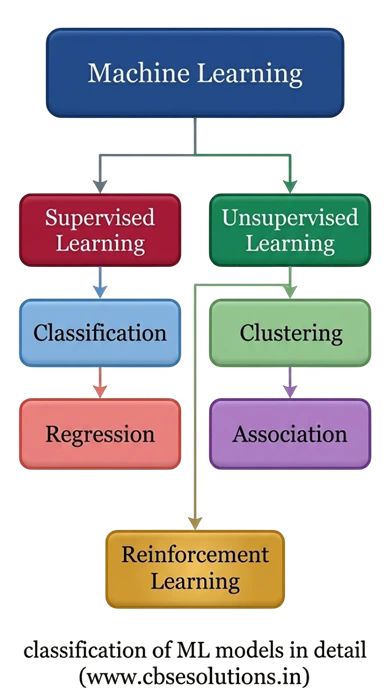
Reinforcement Learning
- Machine learns by trying different actions and learning from mistakes (trial and error)
- Receives feedback as reward (right) or penalty (wrong)
- Improves its decisions over time based on past experience
- Does not need labelled data or predefined answers
- Learns by interacting with its environment continuously
- Best suited for real-life situations where conditions keep changing
- Examples:
- Game Playing – Win games by trying different moves and improving through rewards and penalties
- Self-Driving Cars – Learns when to brake, turn, or accelerate based on feedback from the environment
- Robot Navigation – Robot learns the correct path by avoiding obstacles and reaching the goal
- Online Ads Recommendation – Learns which ads to show to users based on clicks (reward) or no clicks (penalty)
- Traffic Signal Control – Adjusts signal timing based on traffic flow to reduce congestion
Sub categories of Deep Learning
There are two sub categories of DL:
- Artificial Neural Network (ANN)
- Convolution Neural Network (CNN)
Artificial Neural Network
Artificial Neural networks are modelled on the human brain and nervous system. They are able to automatically extract features without input from the programmer. Every neural network node is essentially a machine learning algorithm. It is useful when solving problems for which the data set is very large.
How ANN works?
- A Neural Network is made up of multiple layers, and each layer contains small units called nodes
- Each node performs a task and passes the result to the next layer
- Neural Network consists of Input layer, Hidden layer and Output layer.
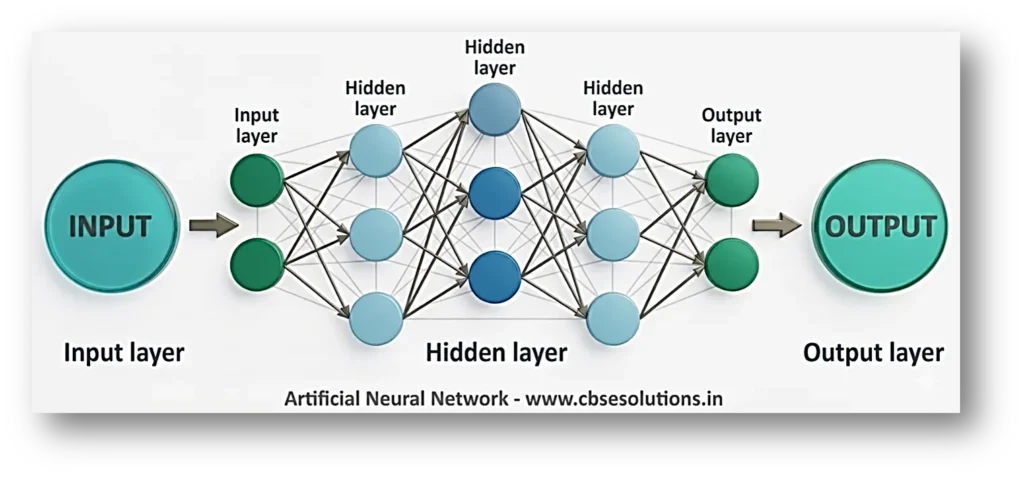
- Input Layer (First Layer):
- Takes input data and sends it forward to Hidden layer.
- No processing happens here.
- Hidden Layers (Next to Input Layer):
- Actual processing happens here. It is not visible to the user.
- Each node has its own algorithm which it applies on data.
- Hidden layers process data using weights and biases, and pass it forward after applying an activation function.
- Output Layer(Final Layer):
- Gives the result/output to the user.
- The network learns through a trial-and-error process until it produces the correct output.
- With each try, Weights are adjusted based on the error between predicted and actual output.
- A neural network can have multiple hidden layers depending on problem complexity
- The number of nodes in each layer can vary
Perceptron – How AI Makes Decisions
- A Perceptron is a simple model of a neural network used to make decisions
- It works like human thinking, where multiple factors affect a decision
Inputs (Factors)
- The perceptron takes multiple inputs (X1, X2, X3, …)
- Example factors:
- Do I have a jacket?
- Do I have an umbrella?
- Is it sunny now?
- What is the weather forecast?
- These inputs are converted into numbers (Yes = 1, No = 0)
Weights (Importance)
- Each input has a weight (W1, W2, …)
- Weight shows the importance of that factor
- More important factor → higher weight
Bias
- Bias is an extra value added to control the decision
- It reflects personal preference (safe or risky decision)
Working (Calculation)
- All inputs are multiplied with their weights
- Then they are added together with bias
- Formula idea: Output = (Inputs × Weights) + Bias
Decision Making
- The result is compared with a threshold (usually 0)
- If result > 0 → Decision = YES
- If result < 0 → Decision = NO
🔗Related Class 10 Evaluating Models Resources
- ✅Practice Advance Concepts of Modeling MCQs
- 📝Solve Advance Concepts of Modeling PYQs
- ❓Advance Concepts of Modeling Imp. Questions
🔗Explore Other Class 10 AI-417 Notes
🔗Explore Other Class 10 AI-417 MCQs
- AI Project Cycle & Ethical Frameworks MCQs
- Evaluatung Models MCQs
- Statistical Data MCQs
- Computer Vision MCQs
- Natural Language Processing MCQs
🔗Other Helpful Resources
- 📚 Class 10 AI Notes
- 📝 Class 10 AI MCQs
- 📄 Class 10 AI PYQs
FAQs – Advance Concepts of Modeling | Class 10 AI (417)
What topics are covered in Class 10 AI Advanced Concepts of Modeling?
Is unit mein mainly rule-based models, learning-based models, supervised learning, unsupervised learning, reinforcement learning, classification, regression, clustering, Artificial Neural Network, Convolution Neural Network and training AI models jaise concepts cover hote hain.
How can I prepare Unit 2 Advanced Concepts of Modeling for the CBSE exam?
Iski padhai karne ke liye aap pahle notes ko padhe, after that MCQ ki regular practice kare, and before exam PYQs & Sample Paper ko revise jaroor kare. Apko class 10 AI ke sabhi Notes, MACs, PYQs and Sample Papers meri isi website me mil jayenge.
What type of questions can be asked from Advanced Concepts of Modeling?
Is unit se MCQs, definitions, differences, scenario-based questions, and application-based questions pooche ja sakte hain.
What is F1 score in AI?
F1 Score ek evaluation metric hai jo precision aur recall dono ko combine karke model ki performance measure karta hai. Ye tab useful hota hai jab precision aur recall dono important hon.
Is Advance Concept of Modeling of Class 10 AI important for the board exam?
Yes, ye ek Class 10 AI ka important unit hai aur every year isse cbse board exam me questions aate hai. students ko ise miss nahi karna chahiye.
What is Advanced Concepts of Modeling in Class 10 AI?
Advanced Concepts of Modeling is Unit 2 of Class 10 AI (417). It focuses on how AI models are created, trained, and used to make predictions or decisions from data.
Frequently Asked Questions of Class 10 AI
Is Artificial Intelligence easy to learn in Class 10?
Haan, Class 10 AI ko generally easy-to-understand subject maana ja sakta hai. Students ko bas basic concepts ko clearly understand karna aur important topics ki regular practice karni chahiye.
What is the total marks of AI (417) in Class 10?
CBSE Class 10 AI (417) ka total assessment 100 marks ka hota hai. Isme 50 marks theory examination ke liye aur 50 marks practical/project work ke liye hote hain.
Can I prepare for the Class 10 AI board exam using only notes?
Class 10 AI notes important concepts ko learn, understand aur revise karne mein kaafi useful hain. However, complete exam preparation ke liye notes ke saath MCQs, PYQs aur important questions solve karna bhi recommended hai. In resources ki links aapko is page par upar mil jayengi.
Which chapters are included in the Class 10 AI (417) syllabus?
Class 10 AI (417) mein AI Project Cycle & Ethical Frameworks, Advanced Concepts of Modeling, Evaluating Models, Statistical Data, Computer Vision, Natural Language Processing (NLP) aur Advanced Python jaise topics included hain. Iske alawa syllabus mein Employability Skills bhi included hain.
Can Artificial Intelligence be a high-scoring subject in Class 10?
Bilkul, Class 10 AI ek high-scoring subject ban sakta hai. Students ko important concepts, definitions, examples aur practical applications ko achhe se prepare karna chahiye. Saath hi, regular question practice exam mein better performance ke liye helpful hoti hai.
How important are MCQs for Class 10 AI (417)?
MCQs Class 10 AI ki preparation mein kaafi useful hain. Inse students important concepts ko quickly revise, apni understanding check aur objective questions ko accurately solve karne ki practice kar sakte hain.