Class 10 Self Management Skills Notes | CBSE Quick Revision Guide
Class 10 Self Management Skills Notes | CBSE Quick Revision Guide
Want to master and score full marks in CBSE Employability Skills?
This Class 10 Self Management Skills Notes are designed with easy explanations and exam-oriented content to help you score high marks with confidence.
This Self-Management Skills Notes of Class 10 are designed by experts and aligned with the CBSE Employability Skills syllabus. They are a must-practice resource to understand all concepts easily, build confidence, and perform your best in the board exams.
🧭 Related Resources
- 🎯Class 10 Employability Skills
- ✅Self-Management Skills MCQs
- 📝Self-Management Skills PYQs
- ❓Self-Management Skills Imp Questions
Self-Management
- Self-management (or self-control) is ability to control emotions, thoughts, and behaviour effectively in different situations.
- It Includes maintaining discipline and timeliness, goal-setting, problem solving and motivation etc.
Key Skills for Effective Self-Management:
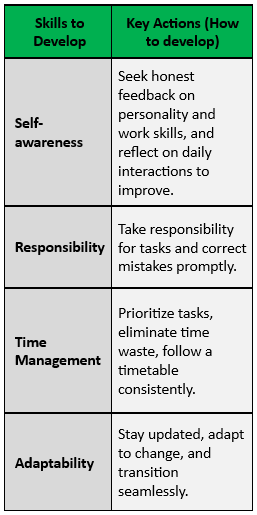
Class 10 Self Management Skills Notes | CBSE Employability Skills Notes
Session 1: Stress Management
What is Stress?
- Emotional, mental, physical, social reactions to any perceived demands or threats (stressors).
- Examples of stressors (reason for stress): exams, loss in family, peer judgment, lack of sleep.
Stress Management
- Managing stress means making a plan to be able to cope effectively with daily pressures, aiming for balance between life, work, relationships, relaxation, and fun.
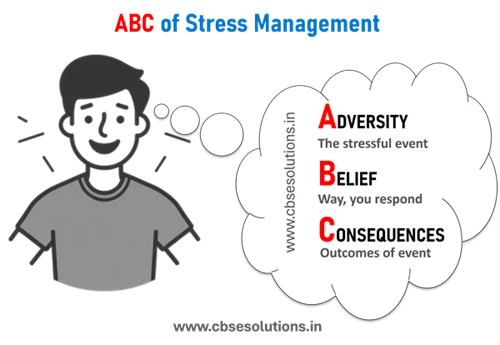
ABC of Stress Management:
Benefits of Effective Stress Management:
- Leads to a joyful, happy life
- Improves focus and timely task completion
- Be a happy person as you are stress free.
- Spend quality time with family and friends
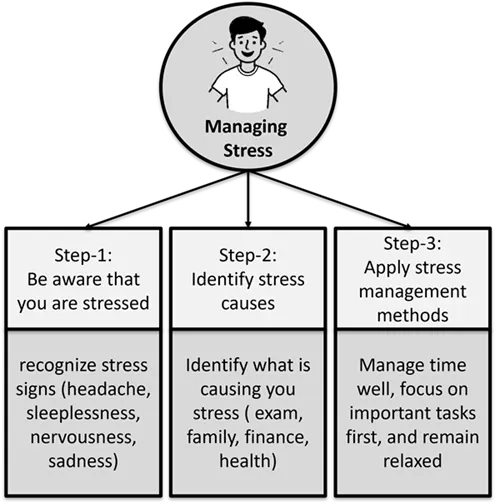
Steps to Manage Stress:
Stress Management Techniques:
- Time management, planning tasks
- Physical exercise, yoga, meditation, deep breathing
- Healthy diet, proper sleep (≥7 hours)
- Positivity, focusing on solutions
- Organizing academic life, completing assignments on time
- Breaks/holidays with family and friends
Emotional Intelligence
- Definition: Ability to recognize and manage your own and others’ emotions.
- Importance: Manage stress, overcome failures, improve relationships, achieve balanced life
Emotional Intelligence Skills:
- Emotional awareness – identify your emotions
- Harnessing emotions – apply emotions to tasks/problem-solving
- Managing emotions – regulate your emotions and help others
Tips to manage Emotional Intelligence:
- Understand your emotions
- Think rationally and avoid abrupt decisions
- Practise yoga and meditations
Self Management Class 10 Notes | Complete CBSE Employability Skills Guide
Session 2: Self-Awareness – Strength & Weakness Analysis
- Self-awareness: Ability to know inner strengths, weaknesses, values, likes/dislikes, beliefs, and skills.
- Why it matters: It helps you identify your strengths and weaknesses, which ultimately helps you improve yourself.
Techniques to Identify Strengths & Weaknesses:
- Finding Strengths:
- Think on tasks you succeed at consistently
- Consider what others appreciate in you
- Take time to think what you do well
- Finding Weaknesses:
- Identify areas where you struggle or face difficulty
- Review feedback from others
- Accept weaknesses as areas for improvement
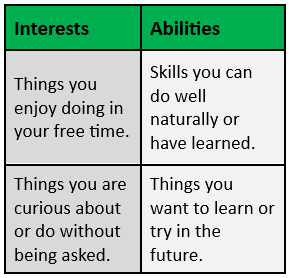
Difference Between Interests & Abilities:
Class 10 Self Management Skills Notes | Quick and Easy Revision
Session 3: Self-Motivation
- Definition: force within you that drives you to achieve goals, feel happy and improve quality of life. Without external influence.
- Examples: Practicing sample papers, complete work on time, preparing for competitive exams.
Types of Motivation
- Internal (Love): Doing things that make you happy, healthy and feel good. Example – dancing, singing etc.
- External (Reward): Doing things that gives recognition, respect, prizes, and appreciation. Example – Participated in high jump and won medal
Qualities of Self-Motivated People:
- Know what they want in life
- Focused, dedicated, and aware of strengths and preferences
- Know what is important
- Dedicated to fulfil their dreams
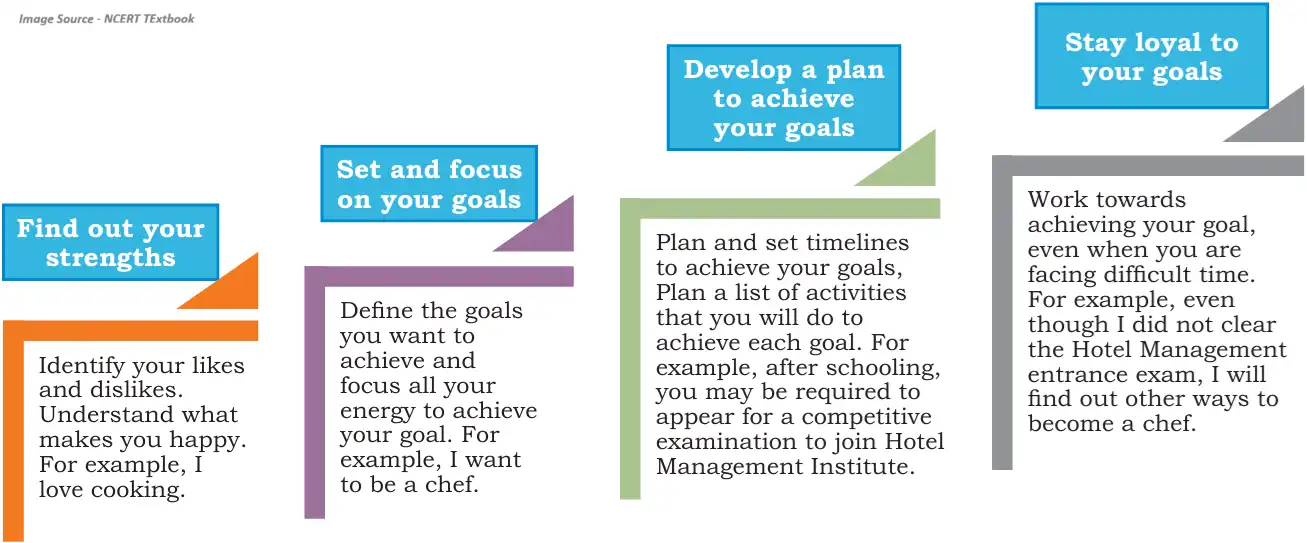
Building Self-Motivation – 4 Steps:
Class 10 Self Management Notes | Quick Revision & Employability Skills Guide
Session 4: Self-Regulation – Goal Setting
- Goals: Set of dreams with a deadline to get them.
- Goal Setting: Finding and listing your goals and then planning on how to achieve them.
How to set Goals:
- Use SMART method to set goals. SMART stands for: Specific – Measurable – Achievable – Realistic – Timely

Session 5: Self-Regulation – Time Management
- Time Management: Planning and controlling how you spend daily hours efficiently.
- Time Management helps you to:
- complete tasks on time.
- make a daily timetable.
- make a good guess at how long it will take you to do something.
- submit homework and assignments on time.
- not waste time during the day.
Steps for Effective Time Management:
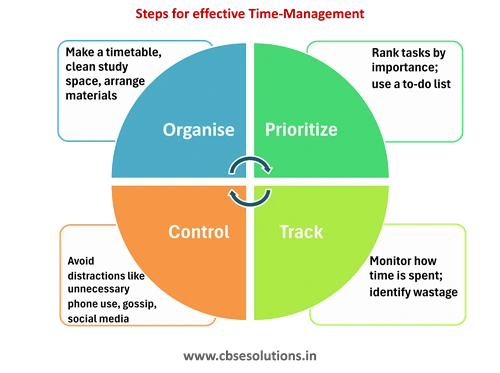
Tips for Practicing the Four Steps for Effective Time Management
- Avoid postponing tasks
- Maintain organized workspace
- develop no disturbance zone where you can complete tasks
- Use waiting time productively
- Prepare ‘to-do’ list
- Replace unproductive activities with meaningful ones
🔗Related Class 10 Self-Management Skills Resources
- ✅Self-Management Skills MCQs with Answers
- 📝Self-Management Skills PYQs with Answers
- ❓Self-Management Skills Imp Questions
🔗Explore Other Class 10 Employability Skills Notes
🔗Explore Other Class 10 Employability Skills MCQs
Class 10 Self-Management Skills – FAQ
Are Class 10 Self-Management Skills notes important for CBSE exams?
Yes, Self-Management Skills, Employability Skills class 10 ka one of the important topic hai aur CBSE board exams me isse every year questions pooche jaate hain.
Are these Class 10 Self-Management Skills notes based on the latest CBSE syllabus?
Yes, ye notes latest CBSE syllabus and updated exam pattern ke according prepared kiye gaye hain.
Do these Class 10 Self-Management Skills notes cover all exam-important topics?
Yes, is notes me sabhi Self-Management skills ke each and every topic ko to-the-point cover kiya gaya hai.
Are Class 10 Self-Management Skills notes enough for exam preparation?
Yes, Ye notes aapko Self-Management skills of class 10 ki complete understanding dete hai, lekin best results ke liye aapko iske PYQs aur MCQs ko bhi revise karna chahiye. Aapko class 10 ICT skills ke sabhi study material ki links meri isi website me mil jayenge.
Which topics are most important to study in Class 10 Self-Management Skills?
Self-Management Skills me following topics are very important – key skills of self management, stress management, self awareness, interest vs abilities, self motivtion, and time-management
Frequently Asked Questions on Employability Skills
Is Employability Skills of Class 10 a separate subject or part of main skill subject?
No, Employability skill is not separate subject. ye sabhi skill subjects jaise IT(402), AI(417), or DS(419) ka CBSE ke new syllabus ke according fixed part hai. Ye sabhi skill subjects ke syllabus me Part-A hota hai jabki Part-B subject-specific hota hai.
What type of questions are asked from Employability Skills in the Class 10 exam?
Mostly Employability skills se MCQs and short Questions exam me pooche jaate hai. aapko employability skills ke sabhi units ke MCQs and Important questions meri website cbsesolutions me mil jayenge.
Which subjects are included in Class 10 Employability Skills?
Class 10 Employability Skills mein Communication Skills, Self-Management Skills, ICT Skills, Entrepreneurial Skills aur Green Skills jaise important skill topics cover kiye jaate hain.
How many marks do Employability Skills carry in Class 10?
Class 10 board exam mein Employability Skills se CBSE ke new syllabus ke according 10 marks (50 mein se) ke questions pooche jaate hain.
Is Employability Skills easy to score full marks in?
Yes, Employability Skill is easy to score full marks. But obviously aako preparation to karni padegi, and iske liye aapko iske Notes and MCQs ko jaroor practice karna chahiye. aapko employability skills class 10 ke all topics ke notes, mcqs, pyqs, and important questions meri website cbsesolutions.in me mil jayenge.