Evaluating Models Notes – Class 10 AI (417)
Here is Class 10 AI Evaluating Model Notes strictly desinged as per Latest CBSE Curriculum. All topics are written keeping Board Exam in focus.
🧭 Related Resources
- 🎯Class 10 Artificial Intelligence(417)
- 🗂️Class 10 Employability Skills
- ✅Evaluating Models MCQs
- 📝Evaluating Models PYQs
- ❓Evaluating Models Imp. Questions
What is Evaluation?
Model Evaluation is the process of checking how well a machine learning model performs using different evaluation metrics
Model Evaluation = Report Card of AI Model
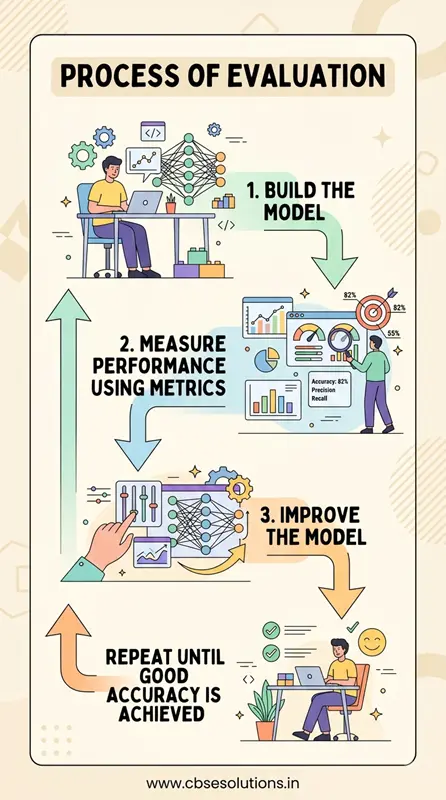
Process of Evaluation
Build the model → Measure performance using metrics → Improve the model → Repeat until good accuracy is achieved
Importance of Model Evaluation
- Uses different evaluation metrics.
- Gives feedback to improve the model
- Helps identify: Strengths and weaknesses
- Makes AI system more reliable and trustworthy
Evaluation techniques
Train-Test Split
✅ What is Train-Test Split?
- The train-test split is a technique for evaluating the performance of a machine learning algorithm
- It can be used for any supervised learning algorithm
- In this dataset is divided into:
- Training Data → Model learns from this
- Testing Data → Model is tested on this
- The train-test procedure is appropriate when there is a sufficiently large dataset available
✅ Need of Train-test split
- To check how well the model performs on new unseen data.
- To ensure the model is learning patterns, not memorizing data.
- To get a realistic estimate of model performance.
- To prevent overfitting (model performing well only on training data).
- To simulate real-world use where predictions are made on unknown data.
Overfitting is a situation where a model is evaluated on the same training data, leading to very high accuracy because it memorizes the data, but performs poorly on new unseen data.
Accuracy and Error
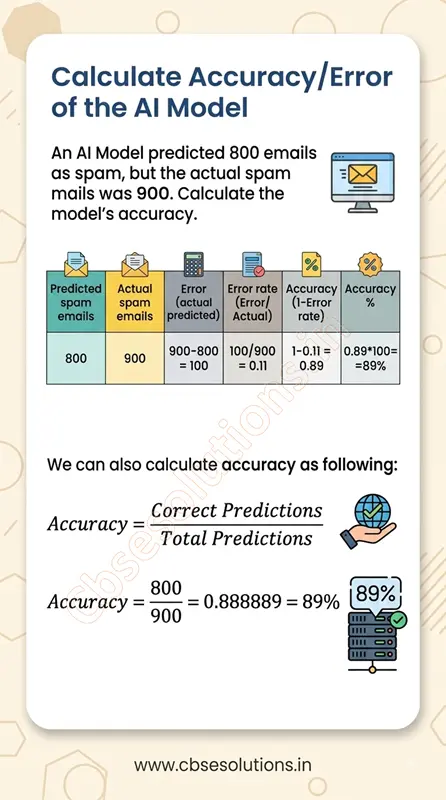
Accuracy
- Accuracy is an evaluation metric that allows you to measure the total number of predictions a model gets right.
- The accuracy of a model is directly proportional to its performance; better performance leads to more accurate predictions.
- Formula:

Error
- Error refers to the difference between a model’s prediction and the actual outcome. It quantifies how often the model makes mistakes.
- Error is used to see how accurately our model can predict data it uses to learn new, unseen data.
- Based on error, the machine learning model that performs best for a particular dataset is selected.
- Formula:

Calculate Accuracy/Error of the AI Model
Evaluation Metrics for Classification
What is Classification?
- Classification usually refers to a problem where a specific type of class label is the result to be predicted from the given input field of data.
- Example: Fruits vs Grocery, Disease: Yes / No , Pass / Fail
Classification Metrics
- Confusion Matrix
- Accuracy
- Precision
- Recall
- F1 Score
Confusion Metrix
- A confusion matrix summarizes a model’s result, showing correct and incorrect predictions in detail.
- It’s a table used to evaluate classification model.
- A confusion matrix is handy for evaluating a model with two or more classes
Confusion Metrix Table
A table that shows actual vs predicted values.
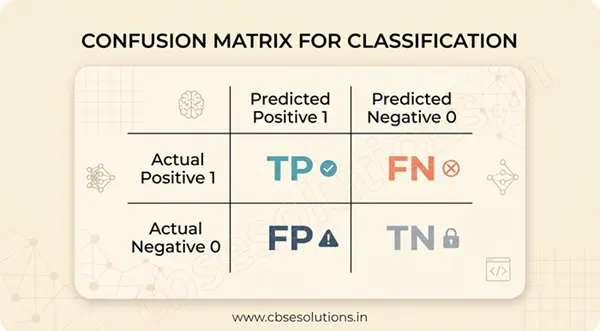
- X-axis shows predicted values
- Y-axis shows actual values
- TP → True Positive → Both Actual & Prediction True
- TN → True Negative → Both Actual & Prediction False
- FP → False Positive → Actual False but Prediction True
- FN → False Negative → Actual True but Prediction False
- 1 → True
- 2 → False
- Numbers in each cell represents how many predictions fall into that category
Understanding True/False Positives and Negatives
| Term | What it Means | Example (Disease) |
| True Positive | Model correctly predicts Positive | Predicted → “Yes, they have disease” Actual → They do have the disease |
| True Negative | Model correctly predicts Negative | Predicted → “No, they don’t have disease” Actual → They don’t have the disease |
| False Positive | Model wrongly predicts Positive | Predicted → “Yes, they have disease” Actual → They don’t have the disease |
| False Negative | Model wrongly predicts Negative | Predicted → “No, they don’t have disease” Actual → They have the disease |
Accuracy from Confusion Matrix
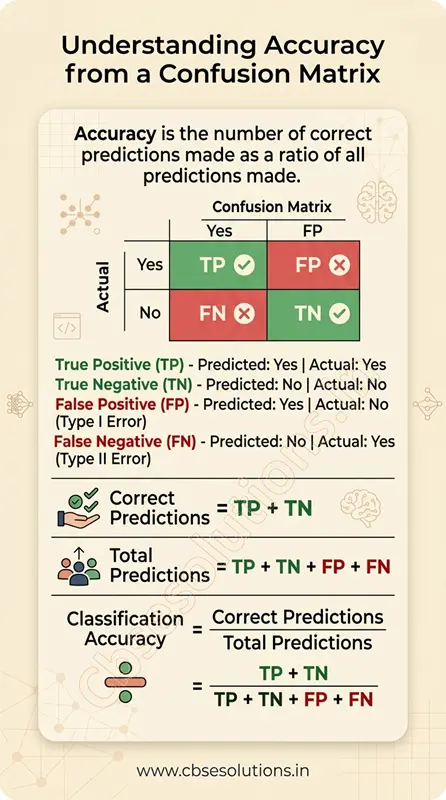
Accuracy works well only when:
- Dataset is balanced
- all predictions and prediction errors are equally important
Construct Confusion Metrix – Calculate Accuracy of Classification model
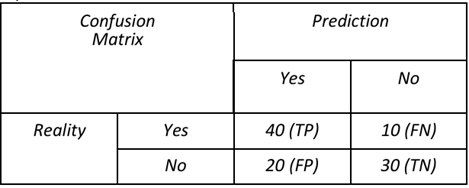
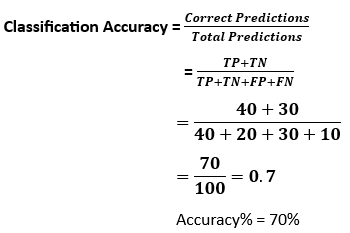
A school recently tested an AI model designed to predict whether students would pass or fail their final exams. Out of 100 students, the model correctly predicted that 40 students would pass and they actually did. It also correctly identified 30 students who were going to fail. However, the model predicted that 20 students would pass, but they ended up failing. Additionally, it predicted that 10 students would fail, but they actually passed.
a) Draw the confusion matrix based on the above information.
b) Calculate the accuracy of this classification model. Show your working.
c) Write the total number of wrong predictions made by the model.
a) Drawing confusion Metrix
b) Calculate accuracy of classification model
c) Wrong predictions = FP + FN = 20+10 = 30
Unbalanced Dataset Problem
- 1000 students in which 900 Pass and 100 Fail
- Model predicts everyone as “Pass”
- Accuracy = 90%. But model is useless! So accuracy alone is misleading.
Precision from confusion metrix
- Precision is the ratio of correctly predicted positive cases to the total predicted positive cases.
- Precision = Correct Postitive Predictions / Total Positive Predictions
- Precision = TP/(TP + FP)
- Out of predicted positives, how many were correct?
Precision: When we should it?
- For unbalanced datasets
- Important when dealing with False Positives (FP) is important
- Focus is to reduce wrong positive predictions
- Ensures predicted positives are mostly correct
Recall (Sensitivity)
- Recall is the measure of our model correctly identifying True Positives.
- Recall = Correct Postivie Predictions / Total Actual Positive Predictions
= TP/(TP + FN)
Recall: Where should we use it?
- Recall is generally used for unbalanced dataset when dealing with the False Negatives become important.
- The model needs to reduce the FNs as much as possible.
- Example:
- Disease detection
- COVID detection
- Fraud detection
F1 Score
- F1 Score combines both precision and recall into a single metric that reflects both properties.
- It is useful for unbalanced datasets, especially when it is unclear whether reducing False Positives (FP) or False Negatives (FN) is more important.
- F1 = (2 x Precision x Recall) / (Precision + Recall)
Use F1 Score when:
- Dataset is unbalanced
- Unsure whether FP or FN is more important
Example: Fraud Detection
- False Negative = Fraud predicted as Normal
- Very dangerous, So Recall should be high.
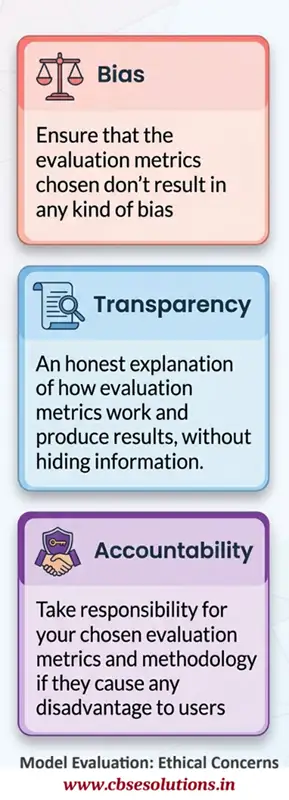
Ethical Concerns in Model Evaluation
🔗Related Class 10 Evaluating Models Resources
- ✅Practice Evaluating Models MCQs
- 📝Solve Evaluating Models PYQs
- ❓Evaluating Models Imp. Questions
🔗Explore Other Class 10 AI-417 Notes
🔗Explore Other Class 10 AI-417 MCQs
- AI Project Cycle & Ethical Frameworks MCQs
- Advanced Concepts of Modeling in AI MCQs
- Statistical Data MCQs
- Computer Vision MCQs
- Natural Language Processing MCQs
🔗Other Helpful Resources
- 📚 Class 10 AI Notes
- 📝 Class 10 AI MCQs
- 📄 Class 10 AI PYQs
FAQs – Evaluating Models | Class 10 AI (417)
What topics are covered in the Evaluating Models unit of Class 10 AI (417)?
Is unit mein mainly model evaluation, training and testing data, confusion matrix, True Positive (TP), True Negative (TN), False Positive (FP), False Negative (FN), accuracy, precision, recall aur F1 score jaise concepts cover hote hain.
What is a confusion matrix in AI?
Confusion Matrix ek table hai jo classification model ki performance ko evaluate karne ke liye use hoti hai. Isme model ke correct aur incorrect predictions ko TP, TN, FP aur FN ke form mein show kiya jata hai.
What is the difference between precision and recall?
Precision predicted positive cases ki correctness par focus karta hai, jabki recall actual positive cases mein se correctly identified cases par focus karta hai.
What is F1 score in AI?
F1 Score ek evaluation metric hai jo precision aur recall dono ko combine karke model ki performance measure karta hai. Ye tab useful hota hai jab precision aur recall dono important hon.
How are confusion matrix-based questions asked in the Class 10 AI exam?
Aise questions mein generally TP, TN, FP aur FN ki values di ja sakti hain aur students se kisi evaluation metric ko calculate karne ya kisi prediction ko identify karne ke liye kaha ja sakta hai.
What type of questions can be asked from Evaluating Models in the CBSE exam?
Is unit se MCQs, objective questions, concept-based questions, confusion matrix-based questions aur calculation-based questions pooche ja sakte hain. Questions mein evaluation metrics aur unke applications par bhi focus ho sakta hai.
Frequently Asked Questions of Class 10 AI
Is Class 10 AI easy or difficult?
Class 10 AI difficult nahi hai, but students ko concepts ko properly understand karna zaroori hai. Agar properly iski preparation ki jaye to ye ek best scoring subject hai.
How many marks does AI-417 carry in Class 10?
CBSE Class 10 AI ka total assessment 100 marks ka hota hai, jisme 50 marks theory aur 50 marks practical/project work ke hote hain.
Are Class 10 AI (417) notes enough for board exam preparation?
Notes concepts aur important points ko understand aur revise karne mein helpful hain, lekin better preparation ke liye notes ke saath MCQs, PYQs and important questions bhi practice karne chahiye. In sabki links aapko is page me upar mil jayegi.
What are the main topics in the Class 10 AI (417) syllabus?
Class 10 AI (417) ke latest syllabus mein AI Project Cycle & Ethical Frameworks, Advanced Concepts of Modeling, Evaluating Models, Statistical Data, Computer Vision, Natural Language Processing (NLP) aur Advance Python jaise topics included hain. Iske saath Employability Skills bhi included hai.