AI Project Cycle and Ethical Framework Notes – Class 10 AI (417)
AI Project Cycle and Ethical Framework Notes | Class 10 AI Quick Revision
Want to score full marks in AI Project Cycle and Etihcal Framework of Class 10 AI (417)?
So Relax! here you will get very comprehesive notes of AI Project Cycle and Ethical framework of class 10 Artificial Intelligence. This AI Project Cycle and Ethical Framework Notes is desinged as per CBSE latest syllabus and covers all topics with easy explainations.
AI Project Cycle – Introduction
- The AI Project Cycle is a step-by-step process used to develop AI-based solutions to real-world problems.
- It ensures that AI projects are organised, efficient, and relevant to real-world needs.
- The AI project cycle has mainly 6 stages.
Stages of AI Project Cycle
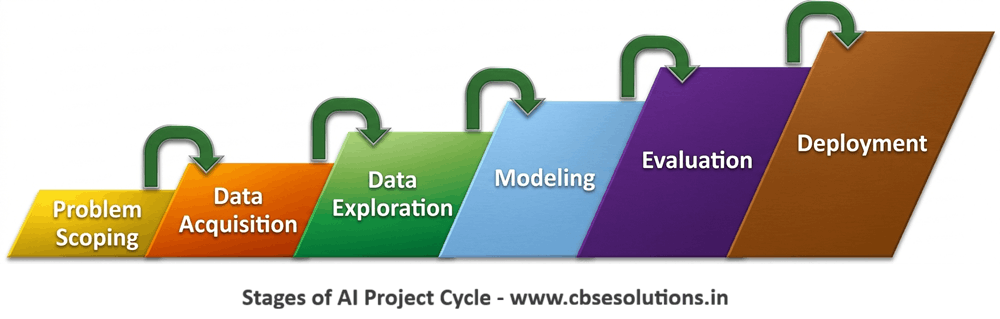
Problem Scoping:
- First stage of the AI Project Cycle.
- We understand the problem and define the goal we aim to achieve.
- We identify the factors that may affect the problem.
Data Acquisition:
- Second stage of AI project Cycle
- It comes after problem scoping and before data exploration.
- Collect relevant data from various sources needed to solve the identified problem.
- Data forms the base of the project
Data Exploration:
- It is third stage of AI Project Cycle.
- Represent data using graphs, databases, flowcharts, maps
- Identify patterns in data and get it ready for building effective AI Model.
AI Project Cycle and Ethical Framework Notes | Class 10 AI Notes
Modelling:
- It is fourth stage of AI Project Cycle.
- Select suitable models based on patterns identified.
- Test selected models and choose the most efficient one.
- Develop algorithm around the selected model.
Evaluation:
- it is fifth stage of AI Project Cycle.
- Test model using new data and improve model based on results.
- It decides if the model is ready to use in real time or not.
Deployment:
- It is 6th stage of AI Project Cycle.
- Integrate AI solution into real-world environment
- Deliver value to users and stakeholders
AI Domains – Introduction
- AI domain is a specific field where AI is applied.
- Each AI domain works on a particular type of data.
- Based on the type of data used, AI is broadly categorised into three domains.
- Statistical Data (Data Science)
- Computer Vision
- Natural Language Processing
Statistical Data (Data Science)
- Statistical data refers to numerical and structured information.
- Deals with collecting, maintaining, and analysing large datasets.
- The extracted information helps in decision-making.
- Example:
- Price Comparison Websites
- Temperature prediction
- Traffic prediction
Computer Vision (CV)
- Enables machines to analyse and understand visual information
- Process includes image acquisition, screening, analysis, and extraction
- Input types: photos, videos, thermal/infrared images
- Objective: teach machines to learn from pixels
- Examples:
- Face recognition
- Self-driving car
- Augmented reality
- Medical imaging
Natural Language Processing (NLP)
- Enables interaction between humans and computers using natural language
- Extracts information from spoken and written language
- Objective: understand and interpret human language
- Examples:
- Machine Translation (Google Translate, Microsoft Translator)
- Email Filters (spam detection)
- Grammer prediction
- Search engine
AI Notes Class 10 | AI Project Cycle and Ethical Framework Notes
Ethical Frameworks for AI
Frameworks
- Step-by-step guides to solve problems
- Ensure organized, consistent, and structured problem-solving
Ethical Frameworks
- Combine ethics (right vs wrong) with frameworks for fair and responsible use.
- Help avoid unintended harm while making decisions and build trust
- Provide systematic approach to moral decision-making
Need for Ethical Frameworks in AI
- Avoid Bias and Discrimination: AI should not produce biased or discriminatory outcomes
- Ensure Transparency: AI systems should make decisions in a clear and understandable manner.
- Promote Ethical Decision-Making: Ethical frameworks help ensure morally acceptable AI choices.
- Prevent Harmful Outcomes: They help identify and avoid risks before AI systems are deployed.
- Ensure Safety and Social Good: Ethical AI should be safe and beneficial for society.
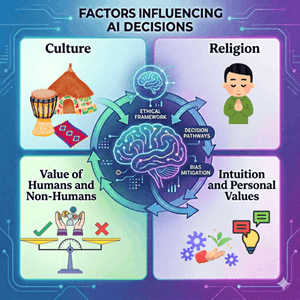
Factors Influencing AI Decisions
- Culture
- Religion
- Value of humans and non-humans
- Intuition and personal values
AI Notes Class 10 | AI Project Cycle and Ethical Framework Notes
Types of Ethical Frameworks
1. Sector-based Frameworks
- Designed for specific industries
- Example: Bioethics (Healthcare)
- Applied in healthcare, finance, education, transport, governance, etc.
2. Value-based Frameworks
- Based on moral principles and values
- Followings are types of Value-based Framework:
- Rights-based:
- Protects human rights and dignity
- Prevents discrimination by AI
- Utility-based:
- Maximizes overall benefit
- Minimizes harm for maximum people
- Virtue-based:
- Focuses on character and intentions
- Emphasizes honesty, compassion, integrity
Bioethics Framework
- Ethical framework for healthcare and life sciences
- Ensures ethical AI use in health-related fields
Principles of Bioethics
- Respect for Autonomy.
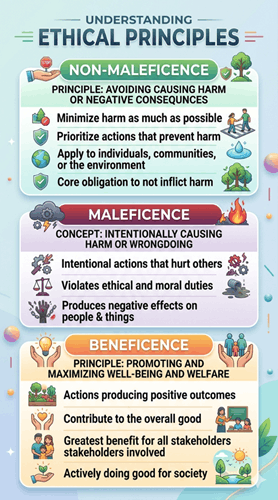
- Do not harm.
- Ensure maximum benefit for all.
- Give justice.
1. Respect for Autonomy
- Users should understand how AI works
- Training data and predictions should be accessible
- Transparency in decision-making
2. Do Not Harm
- Avoid harm to all groups
- Use fair and equitable datasets
- Prevent misallocation of healthcare resources
3. Maximum Benefit
- Aim beyond avoiding harm
- Follow clinical standards
- Use unbiased data reflecting all populations
4. Justice
- Fair distribution of benefits and burdens
- Address societal biases like racism and sexism
- Consider social determinants of healthcare
AI Project Cycle and Ethical Framework Notes | Class 10 AI Notes Code 417
Conclusion
- Ethical frameworks, especially bioethics, help prevent unintended AI consequences
- Ethical AI ensures fairness, transparency, and positive impact