Class 10 AI (417): Evaluating Models PYQ | CBSE Exam Preparation
Prepare for CBSE Class 10 AI Evaluating Models with solved Previous Year Questions (PYQs). Get recent board exam questions, detailed solutions, and clear explanations to strengthen your concepts and score better in the exam.
Q1. A spam e-mail detection system correctly identifies an e-mail as “Not Spam” when it actually is not spam. This represents: [2026]
a) True Positive (TP)
b) True Negative (TN)
c) False Positive (FP)
d) False Negative (FN)
Q2. Which of the following best describes overfitting in the context of train-test split? [2026]
a) The model performs well on both training and test data.
b) The model performs well on training data but poorly on test data.
c) The model performs poorly on both training and test data.
d) The model performs poorly on training data but well on test data.
Q3. Recall is a classification metric that measures: [2026]
a) How many False Positives are correctly identified by the model.
b) How many actual positive cases were correctly identified by the model.
c) How many negative cases were correctly identified by the model.
d) The overall accuracy of the model.
Q4. What is the primary purpose of train-test split in model evaluation? [2026]
a) To increase the size of the dataset.
b) To reduce computational complexity.
c) To estimate the performance of the machine learning model on new data.
d) To improve the accuracy of the training process.
Q5. This ethical concern refers to an honest explanation of how the chosen evaluation metrics work and produce results without keeping any information hidden. Name this ethical concern. [2026]
a) Bias
b) Transparency
c) Accountability
d) Accuracy
Q6. Which of the following best describes model evaluation in Artificial Intelligence? [2026]
a) The process of creating new datasets for training.
b) The process of using different evaluation metrics to understand a machine learning model’s performance.
c) The process of selecting algorithms for model building.
d) The process of data preprocessing and cleaning.
Q7. Define Accuracy. Also give one example to explain why high accuracy does not always mean a model is performing well in real-world situations. [2026]
Q8. (a) Differentiate between Classification Model and Regression Model.
(b) Study the following real-world applications and identify whether each represents a Classification Model or a Regression Model: [2026]
(i) Predicting a patient’s blood pressure reading will be 120/80 mmHg.
(ii) Forecasting that 2,847 units of a product will be sold next month.
(iii) Determining if a patient has “diabetes” or “no diabetes”.
(iv) Predicting that a company’s share price will be ₹1,250.75 tomorrow.
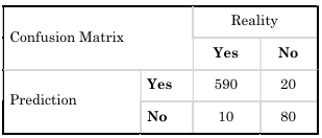
Q9. An AI model has been developed to predict whether electric vehicle batteries need replacement based on performance data. The model was tested on a dataset of 700 vehicles and the resulting confusion matrix is as follows: [2026]
The above Confusion Matrix can also be represented as follows:
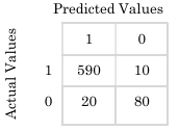
(a) How many total cases are False Positives in the above scenario?
(b) Calculate Precision, Recall and F1 Score.
Q10. Which condition of evaluation does the following diagram indicate? [2025]

a) False Positive
b) False Negative
c) True Positive
d) True Negative
Q11. Statement 1: Overfitting is not recommended for evaluation of a model.
Statement 2: This is because the model will simply remember the whole training set, and will therefore always predict the correct label for any point in the training set. [2025]
a) Both Statement 1 and Statement 2 are correct.
b) Both Statement 1 and Statement 2 are incorrect.
c) Statement 1 is correct but Statement 2 is incorrect.
d) Statement 2 is correct but Statement 1 is incorrect.
Q12. It is one of the parameters for evaluating a model’s performance and is defined as the percentage of true positive cases versus all the cases where the prediction is true. Which evaluation parameter is this? [2025]
a) Precision
b) Recall
c) F1 Score
d) Accuracy
Q13. Which form of learning-based approach does the following diagram indicate? [2025]
[Diagram Placeholder]
a) Clustering
b) Classification
c) Regression
d) Dimensionality Reduction
Q14. With respect to evaluation, for which of the following does the prediction and reality match? [2025]
a) True Positive and False Positive
b) True Positive and True Negative
c) False Positive and False Negative
d) True Positive and False Negative
Q15. Which of the following scenarios might have a high False Negative (FN) cost? [2025]
a) Viral Disease Outbreak
b) Spam
c) Mining
d) Image Search
Q16. Suppose you are developing an AI model to detect fraudulent financial transaction risk. Describe False Positives and False Negatives in this context. [2025]
Q17. An AI model has been developed to test specimens of blood/urine/cough etc. to diagnose ailments (diabetes/liver infection etc.). The model was tested on a dataset of about 630 tests and the resulting confusion matrix is as follows: [2025]
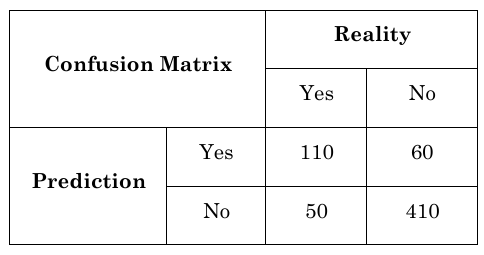
(a) How many total cases are True Negative in the above scenario ?
(b) Calculate Precision, Recall and F1 Score.
Q18. _________ is defined as the percentage of correct predictions out of all the observations. [2025]
a) Precision
b) Accuracy
c) Recall
d) F1 Score
Q19. The following diagram (a scatter plot with a smooth upward-curving best-fit line through the data points) indicates: [2025]
a) Classification
b) Regression
c) Reinforcement Learning
d) Clustering
Q20. When a model is evaluated on the training data, it always predicts correctly. This is known as ___________. [2025]
Q21. In a medical screening test for a specific disease, which scenario represents a True Negative? [2025]
a) A person without the disease tests positive for the disease.
b) A person with the disease tests positive for the disease.
c) A person with the disease tests negative for the disease.
d) A person without the disease tests negative for the disease.
Q22. Draw the confusion matrix for the following data: [2025]
(a) True Positive = 200
(b) True Negative = 50
(c) False Positive = 35
(d) False Negative = 55
| Reality: Yes | Reality: No | |
|---|---|---|
| Prediction: Yes | 200 | 35 |
| Prediction: No | 55 | 50 |
Q23. A sentiment analysis model was built to classify movie reviews as either “Positive” or “Negative”. The model was tested on a dataset of 500 reviews, resulting in the following confusion matrix: [2025]
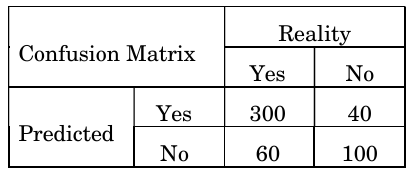
(a) How many total cases are True Positive in the above scenario?
(b) Calculate Precision, Recall and F1-Score.
Q24. During Train-Test Split evaluation, we usually split the data around ___________ between testing and training stages. [2024]
a) 90% – 10%
b) 20% – 80%
c) 100% – 0%
d) 0% – 100%