Entrepreneurial Skills Important Questions Class 12 and Answers
Entrepreneurial Skills Important Questions Class 12 and answers
Worried about scoring well in Class 12 Employability Skills?
Don’t worry — Here are the latest and most relevant important questions and answers from Class 12 Enterpreneurial Skills, prepared according to the CBSE exam pattern and syllabus. This Enterpreneurial Skills class 12 important questions will help you revise smarter and score full marks.
🟩 Short Answer Questions (1–2 Marks)
Q1. Who is an entrepreneur?
👉 Word entrepreneur derived from French word entreprendre (“to undertake”). An entrepreneur is a self-employed person who starts and runs a business to earn profit or create value. They take risks, identify opportunities, and bring new ideas to life.
Q2. What is entrepreneurship?
👉 Entrepreneurship is economic process of generating, developing & implementing an idea under uncertainty to realise profit.
Q3. Define entrepreneurial attitude.
👉 Entrepreneurial attitude refers to a positive, proactive and confident approach toward work. It focuses on taking responsibility, solving problems, and working for the growth of the entire business.
Q4. What is a competency?
👉 Competency is the ability to do a task effectively and efficiently. In entrepreneurship, it refers to the skills and attitudes that enable an entrepreneur to accomplish goals and grow business successfully.
Q5. What do you mean by decisiveness?
👉 Decisiveness means the ability to make quick, clear, and profitable decisions. An entrepreneur becomes decisive by identifying opportunities at the right time and acting on them confidently. It is the most important attribute needed while starting and running a business.
Q6. What is initiative?
👉 Initiative is the ability to take charge and act in a situation before others do. Taking initiative involves believing in your ability, realizing that things are in control, and taking action in a given situation on time.
Q7. Define interpersonal skills.
👉 Interpersonal skills are the abilities that help a person communicate, work efficiently, and build good relationships with others. It helps entrepreneurs collaborate with diverse people respectfully and build strong working relationships. These skills are essential business to grow and do better.
8. What is perseverance?
👉 Perseverance is the ability to continue to do something, even when it is difficult. Perseverance can be built in the following ways:
❇️ Never give up.
❇️ Work hard.
❇️ Learn from failures.
9. What are organisational skills?
👉 Organisational skills refer to the ability of making optimal use of one’s time, energy and resources to achieve one’s goals. Becoming better at these organisational skills would help an entrepreneur become successful.
10. How can stress management help an entrepreneur?
👉 Effective stress management helps an entrepreneur stay calm, think clearly, and stay health. It improves:
❇️ Improve focus
❇️ Enhance decision making
❇️ Increase productivity
Entrepreneurial Skills Important Questions Class 12
🟦 Long Answer Questions (3–5 Marks)
Q1. Explain any four key entrepreneurial attitudes and competencies.
👉 Entrepreneurial attitudes and competencies are essential qualities that help an entrepreneur succeed.
Decisiveness: Decisiveness is the ability to make profitable and quick decisions.
❇️ Initiative: Initiative is the ability to take charge and act in a situation before others.
❇️ Interpersonal Skills: Interpersonal skills are the abilities that help a person communicate, work efficiently, and build good relationships with others.
❇️ Perseverance: Perseverance is the ability to continue to do something, even when it is difficult.
Q2. What is decisiveness? How can it be developed?
👉 Decisiveness means the ability to make quick, clear, and profitable decisions. An entrepreneur becomes decisive by identifying opportunities at the right time and acting on them confidently.
👉 Decisiveness can be developed by:
❇️ Knowing Yourself: Understanding your goals, strengths, and what problems you want to solve.
❇️ Identifying Opportunities: Recognizing when and where to act and whom to help.
❇️ Analysing Opportunities: Studying the market, customer needs, and competition before acting.
❇️ Problem Solving: Refining ideas and making informed decisions that match your strengths.
Q3. What do you mean by initiative? Explain how it can be developed.
👉 Initiative is the ability to take charge and act in a situation before others do. Taking initiative involves believing in your ability, realizing that things are in control, and taking action in a given situation on time.
It can be developed by:
💪 Belief: Trust your ability to act in any situation.
🎯 Realisation: Know that the situation is under your control.
🚀 Action: Respond quickly when the situation requires it.
Q4. Describe interpersonal skills. How can they be improved?
👉Interpersonal skills are the abilities that help a person communicate, work efficiently, and build good relationships with others.
They can be improved through:
❇️ Listening: listen attentively when someone talks and pay full attention.
❇️ Body Language: Maintain pleasant facial expressions, gestures, and body posture.
❇️ Positive Attitude: being optimistic about situations, interactions and oneself.
❇️ Stress Management: Managing emotions and staying calm under pressure and think clearly.
Q5. What is perseverance? How can it help an entrepreneur succeed?
👉 Perseverance is the ability to continue to do something, even when it is difficult. Perseverance can be built in the following ways:
❇️ Not giving up when there is a difficult situation.
❇️ Working hard to achieve the goal.
❇️ Analysing failures and learning from them.
Q6. Explain the importance of organisational skills in entrepreneurship.
👉 Organisational skills vital for making optimal use of one’s time, energy and resources to achieve one’s goals. Becoming better at these organisational skills would help an entrepreneur become successful.
Key aspects of organization skills include:
⏳ Time Management: Plan, prioritise, and set deadlines to accomplish tasks and goals.
🎯 Goal Setting: Define clear aims that provide direction and motivation.
🛠️ Efficiency: Complete tasks effectively without wasting time or resources.
💎 Managing Quality: Maintain high standards of excellence in products or services.
Class 12 Employability Skills Unit-4 Important Questions
🟨 Competency-Based Questions (1-2 Marks)
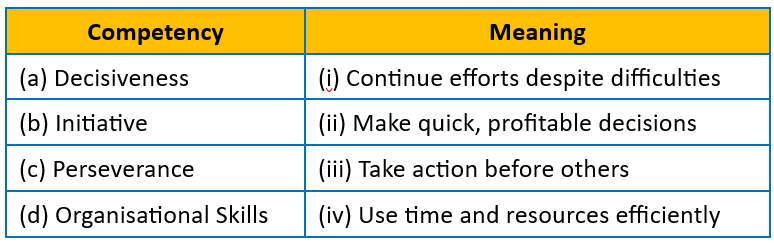
Q1. Match the following entrepreneurial competencies with their meanings
👉 Answer:
(a) – (ii) (b) – (iii) (c) – (i) (d) – (iv)
Q2. Identify the attitude/competency shown in the situation below:
- Ravi faced failure in his clothing shop but didn’t give up. He changed his strategy and succeeded later.
👉 Perseverance. - Shreya regularly plans her day, sets deadlines, and meets all her targets on time.
👉 Organisational skills – specifically Time Management. - Elton convinced his family and started a salon despite doubts and pressure.
👉 Initiative. - Ankur realised his towels sell better in cities than villages and modified his product accordingly.
👉 Decisiveness and Problem-Solving.
Class 12 Enterpreneurial Skills Q&A | CBSE Boards
🟧 Case-Based Questions (4-5 Marks)
Case 1: Nutan’s Story
Nutan, a wheelchair-bound woman, loved cooking. She worked in her neighbour’s restaurant, then started her own dabba (tiffin) service. Later, she introduced a choice-based menu and expanded her business.
👉 Questions:
- Identify whether Nutan was wage-employed or self-employed initially.
- What entrepreneurial quality did Nutan show when she started her own business?
- How did she innovate her service?
- Which entrepreneurial attitude does her story highlight?
- Mention one learning from her story.
👉 Answers:
- Wage-employed (when she worked in a restaurant).
- Initiative and risk-taking.
- By offering a customizable menu.
- Perseverance and positive attitude.
- Where there is a will, there is a way — determination leads to success.