Communication Skills Important Questions Class 12 and Answers
Communication Skills Important Questions Class 12 and Answers
Prepare your Class 12 with Communication Skills Important Questions and Answers. Based on the latest CBSE Employability Skills Syllaus of this year, these are the most probable and frequently asked questions.
🟩 Short Answer Questions (1–2 Marks)
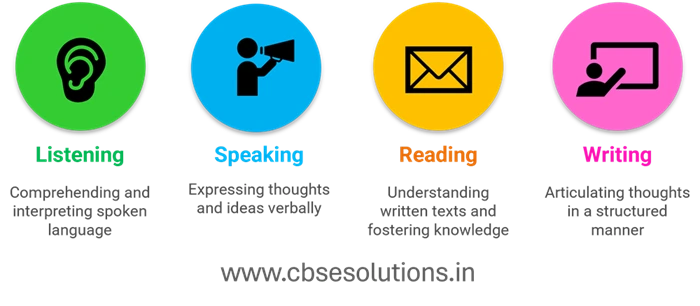
Q1. Define communication. Also Name the four main skills of communication.
Communication is two-way process of exchanging information using language, symbol, sign, or behaviour.
The four main skills of communication are: Listening, Speaking, Reading, Writing (LSRW).
Q2. Give one example of verbal communication and non-verbal communication.
1. Verbal – Talking to a teacher in class.
2. Non-Verbal – Nodding to show agreement
Q3. What is a declarative sentence?
A sentence that provides information or states a fact. Example: “The sun rises in the east.”
Q4. What is an imperative sentence?
A sentence that gives a command, request, or advice. Example: “Please open the window.”
Q5. What does “concise communication” mean?
Communication that is brief and to the point without unnecessary details.
Q6. Explain direct and indirect objects in a sentence with examples.
Direct object: The object that receives the action. Example: “Chaitanya found a wallet.”
Indirect object: The person to/for whom the action is done. Example: “Chaitanya gave his father a wallet.”
Q7. List name of supporting parts of speech.
Articles, Preposition, Conjunctions, and Interjections.
Q8. Explain why communication skills are important in professional life.
Effective communication helps build relationships, avoid misunderstandings, make better decisions, and succeed in career and teamwork.
Q9. How can listening attentively improve understanding and relationships?
Attentive listening ensures correct understanding, shows respect, resolves conflicts, and strengthens personal and professional relationships.
Class 12 Communication Skills Important Questions and Answers
🟦 Long Answer Questions (3–5 Marks)
Q1. Differentiate between verbal and non-verbal communication with examples.

Q2. What is feedback in communication? Explain the importance of feedback in communication with examples.
Feedback is the response given by the receiver to ensure whether they have understood the message.
Importance of feedback:
✅Feedback ensures that the receiver has understood the message correctly.
✅It makes communication two-way.
✅Example: A student nodding after the teacher explains a concept, or replying “Yes, I understood.”
Q3. Explain the difference between active and passive voice with examples.
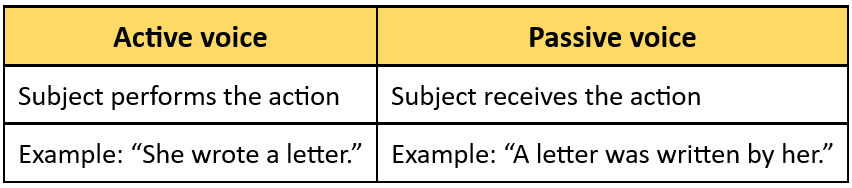
Q4. Explain how barriers affect communication and ways to overcome them.
There are factors like noise surrounding you, past experiences, personal feelings or being pre-occupied affects communication.
Following are the ways to overcome them:
- Keep emotions aside and stay focused
- Avoid phones and other devices
- Create a distraction free environment
- Let the other person finish first and then respond.
Q5. Write examples of four types of sentences: declarative, interrogative, exclamatory, imperative.
- Declarative: “I go to school.”
- Interrogative: “Where are you going?”
- Exclamatory: “What a lovely day!”
- Imperative: “Close the door.”
Q6. Describe the MINTS rules for capitalisation with examples.
- M – Months: June
- I – “I” as a word
- N – Names: Vidya
- T – Titles: Dr. Shah
- S – Starting letter of sentences: “The cat ran.”
Q7. Write short notes on supporting parts of speech (articles, conjunctions, prepositions, interjections).
- Articles: a, an, the
- Conjunctions: and, or, but
- Prepositions: on, in, under, at
- Interjections: wow!, oh!, thanks!
Q8. Explain the process of communication with a diagram.
Communication is the process of exchanging information between a sender and a receiver. It involves:
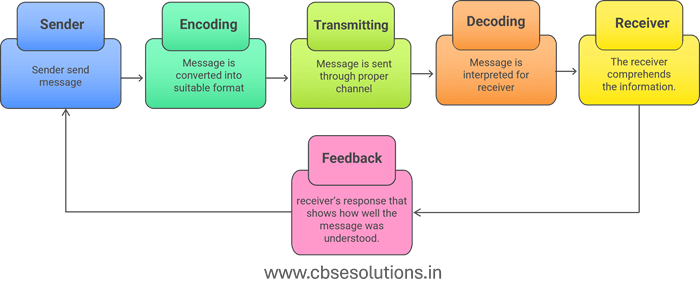
Communication Skills Class 12 NCERT Solutions | CBSE Class 12 Employability Skills Important Questions
Q9. Explain active listening and its stages.
Active listening is giving full attention to the speaker to understand their message.
Stages of Active Listening (RESPECT):
- Receiving: Listening attentively.
- Understanding: Grasping the meaning.
- Remembering: Recalling important points.
- Evaluating: Judging the importance or value.
- Responding: Giving appropriate feedback or reaction.
Q10. Describe the characteristics of effective communication (clear, concise, accurate).
- Clear: Message is easy to understand. Example: “Meet me at 10 AM on Monday.”
- Concise: Message is brief and to the point. Example: “Submit your report by 5 PM.”
- Accurate: Information is factual and correct. Example: “50% of the project is completed.”
Q11. Discuss the use of punctuation marks in communication.
Punctuation marks make writing clear and meaningful.
Examples:
- Full stop (.) → Ends a sentence. “I go to school.”
- Comma (,) → Indicates a pause. “I bought apples, oranges, and grapes.”
- Question mark (?) → Ends a question. “Where are you going?”
- Exclamation mark (!) → Shows strong emotion. “Wow! What a surprise!”
- Apostrophe (’) → Shows possession. “This is Sara’s book.”
Q12. Explain how barriers affect communication and ways to overcome them.
- Barriers: Language differences, distractions, misunderstandings, noise, lack of attention.
- Effects: Confusion, frustration, incorrect understanding.
- Solutions: Clear message, active listening, providing feedback, avoiding distractions.
Q13. Write short notes on supporting parts of speech (articles, conjunctions, prepositions, interjections).
- Articles: a, an, the – used before nouns. “An apple, the sun.”
- Conjunctions: and, or, but – join words or phrases. “Raju and I went to the market.”
- Prepositions: on, in, under, at – show relationship between words. “The book is on the table.”
- Interjections: wow!, oh!, thanks! – show strong emotions. “Wow! That’s amazing!”
Q14. Explain why communication skills are important in professional life.
- Builds relationships and teamwork.
- Reduces misunderstandings.
- Helps in interviews, presentations, and client interactions.
- Improves decision-making and problem-solving.
Q15. How can listening attentively improve understanding and relationships?
- Ensures correct understanding of messages.
- Shows respect and empathy to the speaker.
- Helps resolve conflicts.
- Strengthens personal and professional relationships.
Class 12 Communication Skills Q&A | CBSE Employability Skills Q&A
⚙️ Competency-Based Questions
Q1. During a meeting, your classmate explains a plan in a long, confusing sentence. Using the concepts of clear, concise and accurate communication, how will you reframe their statement?
- I will remove unnecessary details to make it concise.
- Keep only factual points to make it accurate
- Restructure the sentence to express one clear idea at a time (clear).
Q2. Ramu need to request permission from his teacher to leave early. How will he apply clarity in communication while framing the message?
He will provide the exact reason and correct date and time, so that teacher receives complete and clear information.
Q3. While listening to instructions for a project, you find yourself getting distracted by your phone. Which active listening strategies will you apply to stay focused?
I will switch the phone to either silent mode or off, maintain eye contact, and avoid physical distractions to stay attentive.
Q4. Chintamani want to know “Why is punctuation even necessary?” Using your knowledge, how will you explain its importance?
I will explain – Punctuation helps clarifies the correct meaning, separate ideas clearly, and shows emotions or questions. Without it, sentences may become confusing or misleading.
Q5. One of your teammates gives unclear instructions. How will active listening help you avoid misunderstanding?
- By focusing on their words
- Asking for doubt clarification
- Giving feedback to confirm understanding
CBSE Class 12 Communication Skills Important Questions and Answers
📘 Case-Based Questions (5 Marks each)
🌟 CASE STUDY 1
Your school plans a “Communication Skills Workshop.” During the session, the teacher notices that many students are not maintaining eye contact, checking phones repeatedly, and interrupting the speaker. This leads to miscommunication and frustration among participants.
Q1. Which type of listening is missing in this situation?
Active listening.
Q2. Identify TWO factors affecting active listening here.
Lack of eye contact and distractions (mobile phones).
Q3. How can the teacher encourage better listening behaviour?
By asking students to keep devices away, maintain eye contact, and follow RESPECT principles.
Q4. What stage of active listening ensures understanding of the message?
The “Understanding” stage.
Q5. If you were in the workshop, how would you give polite feedback to show you are listening?
By nodding, summarizing the speaker’s points, and responding politely with phrases like “I understand” or “That makes sense.”
🌟 CASE STUDY 2
During an English class, the teacher gives the sentence:
“ran quickly the boy towards school.”
Students must rearrange and identify parts of speech to form a correct sentence.
Q1. What is the correct sentence?
“The boy ran quickly towards school.”
Q2. Identify the verb in the sentence.
ran
Q3. Which word is the adverb?
quickly
Q4. What part of speech is “towards”?
Preposition
Q5. Why is knowledge of parts of speech essential here?
It helps rearrange the words meaningfully and understand their function in the sentence.