Python Stack Notes – Class 12 CS (083) | Complete Revison with Practicals
Learn Python Stack Notes for Class 12 CS (083) covering stack data structure, push and pop operations, stack implementation using lists, and practical programs.
Data Structure
- A data structure is a way to store, organize, and access data efficiently, along with defining the operations that can be performed on it.
- A data structure in which elements are organized in a sequence is called a linear data structure.
- Stack and Queue are important data structures. They are not built-in in Python, but their concepts are widely used and implemented using built-in tools like list, etc.
Stack
- A stack is a linear data structure in which elements are arranged in a sequence.
- It can be understood with real-life examples like a pile of books or a stack of plates.
- In a stack, elements are always inserted at the TOP.
- Similarly, elements are always removed from the top only.
- Both insertion and deletion occur at the same end, called the top of the stack.
- Stack follows the LIFO (Last-In, First-Out) principle, meaning the last inserted element is the first to be removed.
Applications of Stack
- Used to reverse data (like strings, numbers, etc.).
- Used in undo and redo operations in editors (text/image).
- Used in web browsers to manage BACK and FORWARD navigation.
- Used for checking balanced parentheses in expressions.
Operations on Stack
- Two fundamental operations performed on the stack are:
- PUSH
- POP
PUSH in Stack
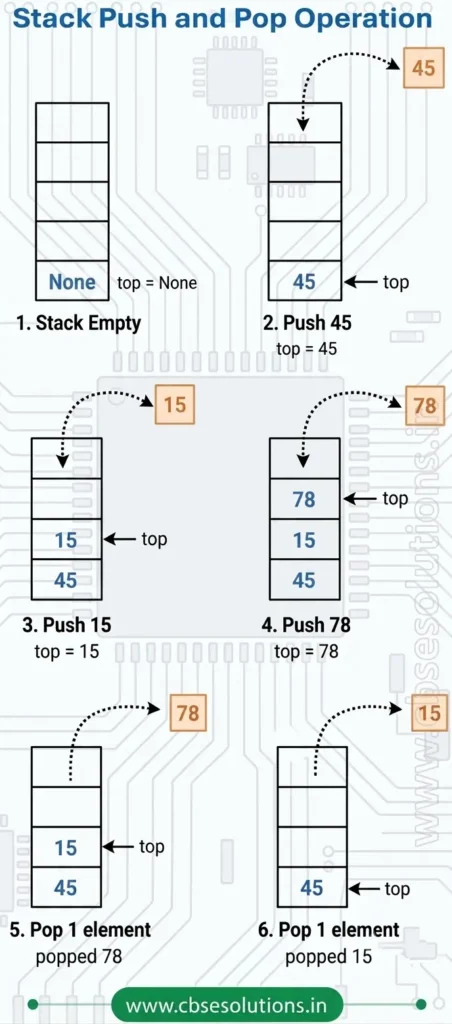
Push is an operation that adds a new element at the top of the stack. It is an insertion operation. A stack can accept elements until it becomes full. If an attempt is made to add an element to a full stack, it causes an exception called overflow.
POP in Stack
Pop is an operation that removes the topmost element from the stack. It is a deletion operation. Elements can be removed until the stack becomes empty. If an attempt is made to remove an element from an empty stack, it causes an exception called underflow.
A stack is used insert and delete elements in LIFO order.
Stack Terms
- Overflow: refers to situation when one tries to push an item in stack that is full
- underflow: refers to situation when one tries to pop an item from empty stack
- Size: refers to total number of items in stack
- Top: insertion and deletion end of stack
Implementation of Stack in Python
- In python List data type is used to implement stack.
- We can use append() method of list to push (insert) item in stack
- We can use pop() method of list to pop(delete) item from stack
- The last element of the list acts as the TOP of the stack.
- Before popping, we should check whether the stack is empty to avoid errors.
Example: Stack Implementation in Python (Books Stack Example)
Let us create a Stack (stack of books) where we perform the following operations:
• Insert elements (PUSH)
• Delete elements (POP)
• Check if stack is empty
• Find number of elements
• Read the topmost element
• Display all elements
Creating an Empty Stack
We create an empty stack named bookStack using a list:
bookStack = list()
Check if Stack is Empty
This function checks whether the stack has no elements.
def isEmpty(bookStack):
if len(bookStack) == 0:
return True
else:
return False
PUSH Operation (Insert Element)
Adds an element at the top of the stack.
def opPush(bookStack, element):
bookStack.append(element)
Size of Stack
Returns the number of elements in the stack.
def size(bookStack):
return len(bookStack)
TOP Operation (Read Top Element)
Returns the most recent element without removing it.
def top(bookStack):
if isEmpty(bookStack):
print(“Stack is empty”)
return None
else:
return bookStack[-1]
POP Operation (Delete Element)
Removes and returns the top element.
def opPop(bookStack):
if isEmpty(bookStack):
print(“Underflow”)
return None
else:
return bookStack.pop()
Display Stack
Displays all elements from top to bottom.
def display(bookStack):
print(“Current elements in the stack are:”)
for i in range(len(bookStack)-1, -1, -1):
print(bookStack[i])
Main Program (Using Stack Operations)
bookStack = list()
# PUSH operations
opPush(bookStack, “Book1”)
print(“Pushing element Book1”)
opPush(bookStack, “Book2”)
print(“Pushing element Book2”)
# Size of stack
print(“Current number of elements in stack is”, size(bookStack))
# POP operation
print(“Popped element is”, opPop(bookStack))
# PUSH new element
opPush(bookStack, “Book3”)
print(“Pushing element Book3”)
# TOP element
print(“Top element is”, top(bookStack))
# Display stack
display(bookStack)
# Remove all elements
while not isEmpty(bookStack):
print(“Popped element is”, opPop(bookStack))
print(“Stack is empty now”)
Output (Expected)
Pushing element Book1
Pushing element Book2
Current number of elements in stack is 2
Popped element is Book2
Pushing element Book3
Top element is Book3
Current elements in the stack are:
Book3
Book1
Popped element is Book3
Popped element is Book1
Stack is empty now