Class 10 AI (417): Advance Concepts of Modeling PYQ | CBSE Exam Preparation
Ace Your CBSE Exam with Class 10 AI Advance Concepts of Modeling Previous Year Questions!
Explore Advance Concepts of Modeling PYQ for CBSE board prep. This collection includes solved previous year questions from recent CBSE board exams, along with expert and exam oriented solutions.
Q1. Artificial Neural Networks are inspired by: [2026]
a) Computer circuits
b) Mathematical equations
c) Human brain and nervous system
d) Internet networks
Q2. In unsupervised learning, the machine’s primary task is to: [2026]
a) Predict specific outputs.
b) Identify patterns and relationships in unlabelled data.
c) Classify data into pre-defined categories.
d) Learn from rewards only.
Q3. A music streaming service groups songs by tempo and intensity to understand user preferences. This is an example of: [2026]
a) Supervised learning – Classification
b) Unsupervised learning – Clustering
c) Reinforcement learning
d) Supervised learning – Regression
Q4. A company wants to detect manufacturing defects where examples of both normal and defective products are available. They should use: [2026]
a) Unsupervised learning
b) Reinforcement learning
c) Association rules
d) Supervised learning
Q5. Give any two characteristics of Artificial Neural Networks. [2026]
Q6. Provide one real-world application each of Supervised Learning and Unsupervised Learning. [2026]
Q7. A smart city project wants to implement an integrated AI system. For each of the following requirements, identify the most appropriate AI domain and justify your choice: [2026]
(a) Analyzing traffic camera footage to count vehicles and detect traffic violations automatically.
(b) Processing citizen complaints written in local languages to categorize them as “water supply”, “electricity”, or “waste management” issues.
Q8. (a) Explain Reinforcement Learning with an example. [2026]
(b) A drawback of the Rule Based Approach is that learning is static. Explain the given statement.
(a)
Reinforcement Learning is a type of Machine Learning in which an AI agent learns by trial and error. It receives rewards for correct actions and penalties for wrong actions.
Example: A robot learns to walk by getting rewards for correct movements and penalties for falling.
(b)
In a Rule-Based Approach, the system follows predefined rules made by humans. It cannot learn or improve from new data or experience unless the rules are manually updated.
Example: A rule-based chatbot gives only the answers already programmed into it.
Q9. The following diagram (a scatter plot with a smooth upward-curving best-fit line through the data points) indicates: [2025]
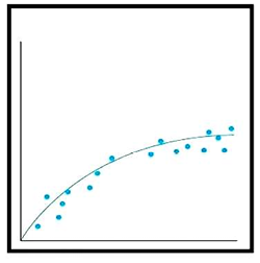
a) Classification
b) Regression
c) Reinforcement learning
d) Clustering
Q10. In a neural network, what is the function of the input layer? [2025]
a) It performs mathematical operations on the input data.
b) It connects neurons to the output layer for predictions.
c) It receives and passes the raw input data to the hidden layers.
d) It stores weights and biases for neural network training.
Q11. Explain the following with respect to Unsupervised Learning Models: [2025]
(a) Clustering
(b) Dimensionality Reduction
(a) Clustering
Clustering is an unsupervised learning technique that groups similar data points into clusters based on their similarities, without using labelled data.
Example: Grouping customers based on their shopping behaviour.
(b) Dimensionality Reduction
Dimensionality Reduction is an unsupervised learning technique that reduces the number of input features while preserving the important information in the data.
Example: Reducing image features to make processing faster.
Q12. Give names of any two online and any two offline sources of data. [2025]
Q13. Which form of learning-based approach does the following diagram indicate? [2025]
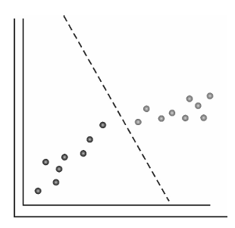
a) Clustering
b) Classification
c) Regression
d) Dimensionality Reduction
Q14. Whenever we want an AI project to be able to predict an output, we need to _________. [2025]
a) first test it using the data.
b) first train it using the data.
c) Both (A) and (B)
d) Neither (A) nor (B)
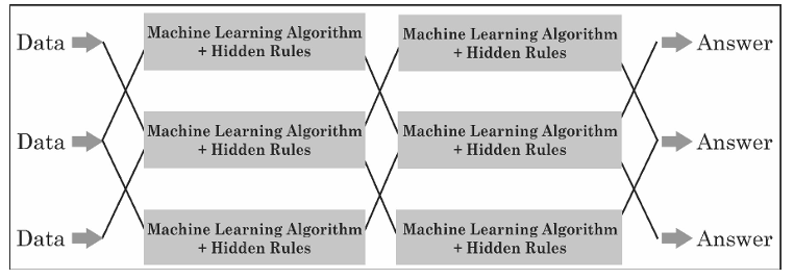
Q15. Consider the following diagram. It explains how a system of organized machine learning algorithms perform certain tasks. Identify the concept and explain its working. [2025]
Q16. What is a Capstone Project? Give any two examples.