Class 12 Self-Management Skills Notes | Quick Revision for CBSE Boards
Are you ready to score full marks in Employability Skills?
Then start with this Class 12 Self-Management Skills Notes, prepared by experts and aligned with the latest CBSE syllabus. These notes of self-management of class 12 cover all essential topics (See Table of Content below) which are explained in short and clear pointers. They are designed to make your last-minute revisions easy and effective.
So start revising smartly today! 😊
Class 12 Self-Management Skills Notes | CBSE Employability Skills Notes
Session 1: Self Mangement
What is Self-Management
- Self-management (Self-control) is the ability to regulate emotions, thoughts, and behaviour effectively in different situations.
- Self-management helps improve essential skills such as:
- Being on time
- Stay discipline
- Solving problems
- Working in organized manner.
- Students with strong self-management are punctual, disciplined, focused, and respectful.
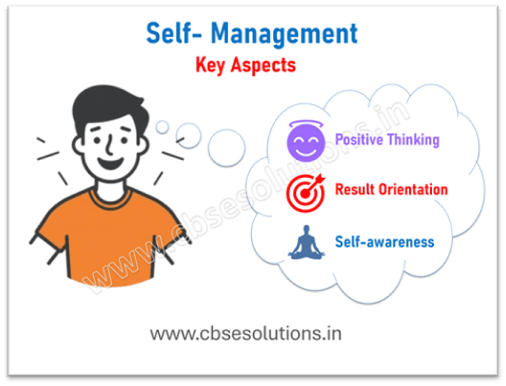
Ways to improve self-management | Core Aspects of Self-Management
- Positive Thinking → Believing in ability to get things done and be happy.
- Result Orientation → Aim high and stay focused to get desired results.
- Self-awareness → Be aware of one’s strengths/weaknesses, and make the best use of strengths.
Session 2: Motivation and Positive Attitude
Motivation
- Motivation comes from the word ‘motive’, which means the driving force that directs our actions towards a goal.
- It is a mental attitude based on belief and hope which help us achieve our dreams and stay focussed on success.
Types of Motivation:
- Intrinsic Motivation: When motivation comes from within to do something without expecting any reward is called Intrinsic motivation. Intrinsic motivation makes people engage in activities because they enjoy them, feel satisfied, or find personal happiness.
- Extrinsic Motivation: When motivation comes from external rewards such as money, recognition, incentives is called extrinsic motivation. Extrinsic motivation drives people to engage in activities to gain respect, recognition and appreciation.
- Class 12 Self Management Skills Notes
Class 12 Self-Management Skills Notes | CBSE Employability Skills Notes
Positive Attitude
- Positive attitude leads to happiness, make better decisions, maintain stronger relationships, and success.
- Positive attitude Improves mental and physical health.
- Positive attitude helps people handle challenges better and move forward more easily unlike negative attitude.
How to maintain a Positive Attitude | Ways to maintain positive attitude
- Start the day with a routine that includes affirmations, smiling, and listing tasks to accomplish.
- Feed your mind with positivity by reading motivating books, listening to uplifting music, and watching inspiring movies.
- Be proactive → control how you feel despite circumstances.
- Focus on solutions, not problems.
- Learn from failures and keep working towards the goal.
- Be cheerful and keep working hard to achieve dreams.
Long-term techniques to maintain positive attitude:
- Physical Exercise & Fresh Air: Do Yoga, meditation, outdoor play.
- Healthy Diet: Eat Balanced food for strength and efficiency.
- Organise Academic Life: Keep Notes, complete assignments, track deadlines.
- Adequate Sleep: 7 hours minimum sleep for recharge of mind and body.
- Holidays & Breaks: Spend time with family/friends to refresh.
Value of Positive Attitude in Student Life
- Helps in exams → accept results, keep working harder.
- Job interviews → even if rejected, stay persistent and positive.
- Essential for success in all aspects of life.
Session 3: Stress Management
What is Stress?
Stress is state of feeling upset, hopeless, or unable to achieve goals. It may affect both mental and physical health. Stress can be managed with self-control and positive attitude.
Ways to Manage Stress:
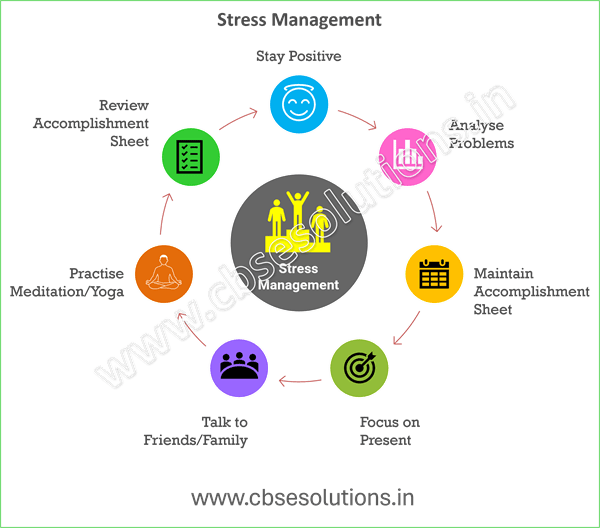
Class 12 Self-Management Skills Notes | Self-Management Skills Quick Revision Class 12
Session 4: Result Orientation
- Result Orientation is the ability to recognise important results and focus on the steps required to achieve them. It Focuses on outcomes of task rather than the process.
- An ideal individual is proactive, goal-driven, and takes necessary steps to achieve targets.
How to Become Result-Oriented
- Set Clear Goals – First step towards meeting targets.
- Prepare an Action Plan – Gives details of actions/steps/changes to be taken to achieve target. Each action/step/change include following information:
- What changes will occur?
- Who will carry them out?
- When changes will take place?
- How long will the change stay?
- What resources are needed?
- Who to communicate with and what to share?
- Use the Right Resources/Tools – Ensure availability of books, materials, or guidance.
- Communicate with Mentors & Peers – Seek help from mentors/peers in setting realistic goals.
- Make a Calendar – Monitor progress regularly.
- Work Hard – Believe in dreams and keep working hard.
Goal Setting
- Goal Setting helps to identify what we want, how to achieve it, and how to measure success.
- Goal setting should be clear, easily understood, with a defined purpose and objective.
How to set a goal?
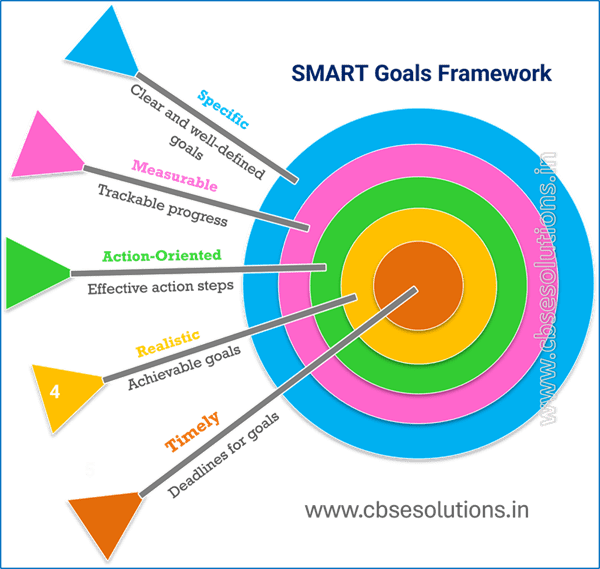
we can use SMART model for setting our goals.
SMART Goals
Examples of Result-Oriented Goals
- A student sets a goal of scoring high marks.
- An athlete runs 5 miles daily.
- A traveller plans to reach a city in 3 hours.
Self-Management Skills Notes Class 12 | CBSE Exam Preparation
Session 5: Self-Awareness
- Self-awareness refers to understanding one’s needs, desires, habits, traits, behaviours, and feelings.
- Lack of self-awareness leads to confusion and unclear direction.
- Helps in understanding oneself, others, and the world objectively.
Steps Towards Self-Awareness
- Be aware of emotions.
- Track and record feelings.
- Expand awareness to different areas of life.
Personality and Personality Traits
- Personality → Cluster of thoughts, feelings, and behaviours that make a person unique.
- Personality traits → Long-lasting patterns of thoughts, feelings, and behaviour that distinguish individuals.
- Personality develops through temperament, character, environment, and culture.
Five Factor Model (FFM) | The Big Five Personality Traits
- Openness – Individual with openness is creative, curious, adventurous.
- Conscientiousness – Individual with Conscientiousness is disciplined, responsible, caring.
- Extraversion – Individual with Extraversion is outgoing, talkative, confident.
- Agreeableness – Individual with Agreeableness is Kind, cooperative, sympathetic, warm and considerate.
- Neuroticism – Individual with Neuroticism are anxious, insecure, prone to negative emotions.
Common Personality Disorders
Cluster A: Suspicious
People falling under this cluster always mistrust others and are suspicious, even when there is no need to do so.
- Paranoid Personality Disorder → Distrust for others, holding grudges against others.
- Schizoid Personality Disorder → Person is detached, aloof, and prone to interoception, avoids relationships.
- Schizotypal Personality Disorder → Odd beliefs, misinterprets behaviours, avoids intimate relationships.
Cluster B: Emotional & Impulsive
- Antisocial Personality Disorder → Ignores social rules, aggressive, impulsive, and irritating.
- Borderline Personality Disorder → Emotional instability, low self-worth, violent and impulsive, self-harm tendencies.
- Histrionic Personality Disorder → Overly dramatic, attention-seeking, can be easily influenced by others.
- Narcissistic Personality Disorder → Sense of self-importance, lack of empathy for others.
Cluster C: Anxious
- Avoidant Personality Disorder → socially inept, unappealing or inferior, and constantly fear being embarrassed, criticised or rejected.
- Dependent Personality Disorder → Lacks self-confidence, heavily dependent on others for their needs.
- Obsessive-Compulsive Personality Disorder → Excessive concern with orderliness, perfectionism and attention to details.
Steps to Overcome Personality Disorders
- Talk to someone and share feelings.
- Maintain healthy body.
- Build self-confidence.
- Engage in hobbies (music, dance, painting).
- Stay positive by choosing words like ‘challenges’ instead of ‘problems’
Class 12 Self-Management Skills Notes – FAQ
Q1. Are Class 12 Self-Management Skills notes important for CBSE exams?
Yes, Self- Management Skills Notes of Class 12, CBSE exam ke liye important hai. Isse every year CBSE Board exams me questions puchhe jaate hai, and ye Class 12 Employability Skills ka one of the most important unit hai.
Q2. Are these Class 12 Self-Management Skills notes based on the latest CBSE syllabus?
Yes, Self-Management Skills Class 12 ke notes latest CBSE syllabus pe based hai. And humne ise prepare karte samay latest exam pattern ko bhi dhyan me rakha hai.
Q3. How many marks questions come from Self-Management Skills in Class 12 CBSE board exams?
Exact marks har saal ke exam pattern par depend karte hain, lekin self-management skills class 12 se generally 2-4 marks ke questions hote hai.
Q4. Do these Self-Management Skills notes of Class 12 cover all exam-important topics?
Yes, Ye Self-Management Skills Class 12 ke notes CBSE exam se related all important topics ko cover karte hai. Isme CBSE Employability Skills ke syllabus ke according sabhi topics like – Core Aspect of Self Management, Self Awareness, Goal Setting, Motivation and Positive Attitude, Result Orientation, SMART goals, Common Personality Disorder etc. ko cover kiya gaya hai.
Q5. Are Class 12 Self-Management Skills notes enough for exam preparation?
Yes, Ye notes aapko self-management skills of class 12 ki complete understanding dete hai, lekin best results ke liye aapko MCQs, Sample Papers, and PYQs ko bhi revise karna chahiye. Aapko class 12 self-managment skills ke sabhi study material, sample papers, MCQs, PYQs, textbook solutions meri isi website cbsesolutions.in me mil jayenge. Unke links aapko upar menu me aur neeche bhi mil jayenge.
Q6. What type of questions can be asked from Self-Management Skills in CBSE Class 12 exams?
Jyadatar exams me class 12 self-management skills se MCQs, short answer questions, and definition-based questions pooche jaate hain. MCQs competency based ho sakte hai.
How can these Class 12 Self-Management Skills notes help in scoring better marks?
Aapko ye Self-management skills of class 12 ke notes definitely better marks score karne me help karte hai, because isme sabhi topics ko very comprehensively, simple language me and point wise prepare kiya gaya hai jo apko minimum time and effort me sabhi concepts ki understanding dete hai.
Class 10 Employability Skills – Student’s Common Questions
Are Employability Skills important for the CBSE Class 12 board exam?
Yes, Agar aapne CBSE Skill subjects (like – IT, AI, Data Science, Financial Market etc) opt kiya hai, to Employability Skills CBSE Class 10 board exam ke liye important hai.
How many marks are allotted to Employability Skills in CBSE Class 12?
Employability Skills ka weightage total theory marks ka 20% hota hai. Jaise, agar theory paper 50 marks ka hai, to usme 10 marks Employability Skills ke hote hain.
What topics are included in CBSE Class 12 Employability Skills?
CBSE Class 12 Employability Skills me 5 main topics or units hai – Communication Skills, Self-Management Skills, ICT Skills, Entrepreneurship Skills, and Green Skills. In sabhi topics ke complete notes, mcqs, pyqs, sample papers, textbook solutions aapko hamari isi website ‘cbsesolutions.in’ me available hai.
Where can I find Class 12 Employability Skills Notes?
Aapko class 12 employability skills ke sabhi topics(units) ke complete noteshamari isi website ‘cbsesolutions.in’ me mil jayenge. aap inhe upar navigation menu me jakar ya is post ke neech diye hue link me click kar prapt sakte hai.
Where can I find Class 12 Employability Skills MCQs?
Aapko class 12 employability skills ke sabhi topics(units) ke MCQs hamari isi website ‘cbsesolutions.in’ me mil jayenge. aap inhe upar navigation menu me jakar ya is post ke neech diye hue link me click kar prapt sakte hai.
Where can I find Class 12 Employability Skills PYQs?
Aapko class 12 employability skills ke Previous Years ke Questions with Answers hamari isi website ‘cbsesolutions.in’ me mil jayenge.
Are these Employability Skills study materials based on the latest CBSE Class 12 syllabus?
Absolutly Yes
Are notes enough for Employability Skills exam?
Yes, Class 12 Employability Skills Notes, exam ke liye bahut important and enough hai, but aapko PYQ and MCQs bhi prepare karne chahiye kyonki use aapko question pattern and types of questions ki understanding ho jati hai. aap Class 12 Employability Skills MCQs and Class 12 Employability Skills PYQs ke liye meri isi website cbsesolutions.in me prepare kar sakte hai.