Class 12 Green Skills Notes | Quick & Easy Employability Skills Guide

Really want to master in Employability Skills and score high in CBSE Boards?
Explore these Class 12 Green Skills Notes, carefully prepared by subject experts as per the latest CBSE Employability Skills syllabus.
Session1: Green Jobs
- Jobs that help protect and restore the environment.
- Found in all sectors: traditional (manufacturing, construction) & new (renewable energy).
UNEP says: Green jobs (or green collar jobs) are roles in agriculture, administration, R&D, manufacturing, and services that help preserve or restore environmental quality.
Green Collar Workers
- Found in the environmental sectors of the economy
- Include professionals: green architects, environmental consultants, lawyers, engineers, organic farmers.
- Include skilled workers: solar/wind installers, energy-efficient building workers, technicians in clean energy.
- Enterprise Contribution: Produce eco-friendly goods/services (green buildings, clean transport), reduce water consumption, improve recycling, lower emissions.
Class 12 Green Skills Notes
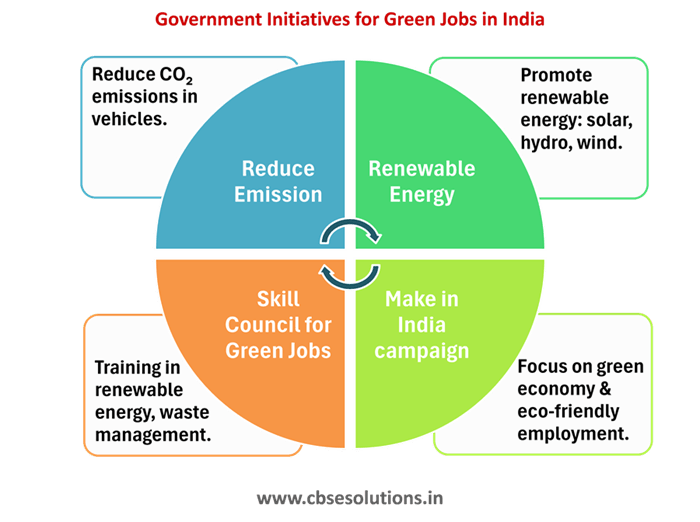
Government Initiatives for Green Jobs in India
Benefits of Green Jobs
- Increase efficient use of energy & raw materials.
- Reduce greenhouse gas emissions.
- Control waste & pollution.
- Protect & restore ecosystems.
- Adapt to climate change.
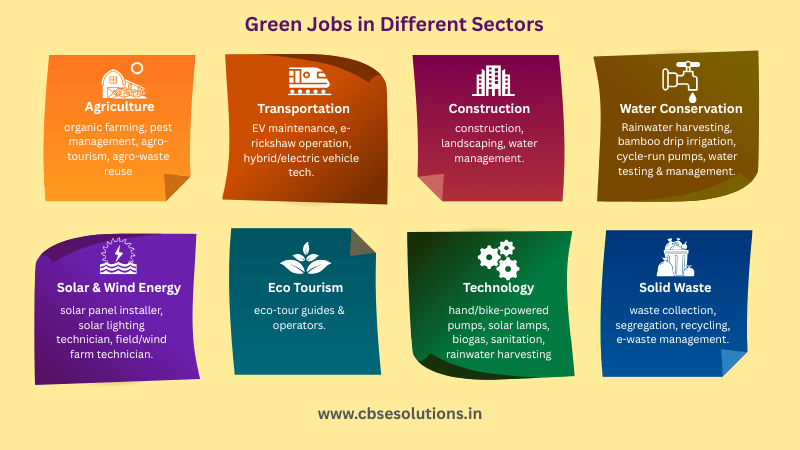
Green Jobs in Different Sectors
Class 12 Green Skills Notes
Agriculture
- Agriculture: organic farming, pest management, agro-tourism, agro-waste reuse.
- Transportation: EV maintenance, e-rickshaw operation, hybrid/electric vehicle tech.
- Water Conservation: Rainwater harvesting, bamboo drip irrigation, cycle-run pumps, water testing & management.
- Solar & Wind Energy: solar panel installer, solar lighting technician, field/wind farm technician.
- Eco-Tourism: eco-tour guides & operators.
- Building & Construction: construction, landscaping, water management.
- Solid Waste Management: waste collection, segregation, recycling, e-waste management.
- Appropriate Technology: hand/bike-powered pumps, solar lamps, biogas, sanitation, rainwater harvesting, farm mechanisation.
Session 2: Importance of Green Jobs
Limiting Greenhouse Gas Emissions
- Greenhouse gases: emitting due to fossil fuels (CO₂, methane, nitrous oxide, ozone, CFCs) and cause Global Warming.
- Solution: use cleaner fuels (CNG, renewable energy), reduce fossil fuel use.
Minimising Waste & Pollution
- Reuse scrap material (paper mills, plastics, damaging rolls).
- Ensuring quality control – Reduce waste, decrease in defective products.
- Waste exchange – reducing waste disposal through re-use.
- Manage e-waste (old mobiles, laptops, TVs).
- Use eco-friendly materials (banana leaf plates).
Protecting & Restoring Ecosystems
- Ecosystem – perfect balance where living and non-living things interacting and supporting each other.
- Threats: deforestation led to destruction of the ecosystem, causing climate change and natural disasters,
- Solutions: forestation, vegetation, soil health investment, greenhouse gas emission control
Adapting to Climate Change
- Find ways to survive in the new climatic conditions. Example – Farmers need to grow drought-resistant crops.
- Action Plan – In June 2008, NAPCC launched 8 missions to address and adapt to climate change:
- Solar energy, energy efficiency, habitat, water, Himalayan ecosystem, forestry, agriculture, climate knowledge.